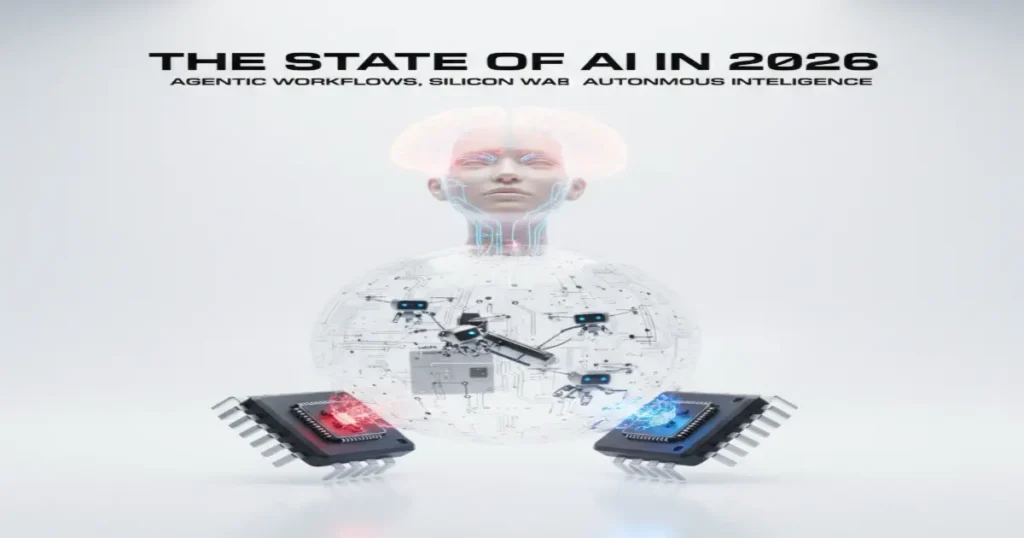
The State of AI in 2026: Agentic Workflows, Silicon Wars, and the Dawn of Autonomous Intelligence
The Defining Era of Artificial Intelligence: 2026
The year 2026 has cemented itself as the defining inflection point in the history of artificial intelligence, marking a profound transition from conversational generative models to fully autonomous, agentic systems. As recently as early 2025, the global conversation was overwhelmingly dominated by large language models that primarily responded to human prompts with static text, code, or images.
Today, the technological landscape has fundamentally transformed. We have entered the era of the ‘digital collaborator,’ where AI systems do not merely explain how to perform tasks, but actively execute them across complex, interconnected software environments.
This shift is being driven by unprecedented advancements in context window sizes, reasoning capabilities, and continuous software interaction frameworks. For instance, recent capabilities introduced by major tech laboratories allow AI to open applications, navigate web browsers, fill in vast spreadsheets, and execute multi-step desktop workflows entirely from a single mobile prompt. The velocity of these breakthroughs is staggering.
In just the first quarter of 2026, the industry has witnessed a tidal wave of new frontier models, fierce geopolitical tensions over AI deployment, and a radical reshaping of enterprise economics. AI adoption is now universal; it is no longer a peripheral experimental technology but the central pillar of modern business strategy, governance, and infrastructure.
The long-standing debate over whether artificial intelligence will disrupt the global workforce has definitively ended; the disruption is here. Current economic projections indicate that while AI displaces tens of millions of traditional roles globally, it simultaneously creates millions of new positions that require fundamentally different skill sets, such as managing autonomous agents and orchestrating complex AI-driven workflows.
In this comprehensive 2026 expert analysis, we will rigorously deconstruct the technological breakthroughs, enterprise shifts, hardware innovations, and geopolitical conflicts that are redefining the future of human intelligence and machine collaboration.
The Frontier Model Tsunami: February and March 2026 Releases
The first quarter of 2026—particularly the months of February and March—will be recorded as one of the most prolific, highly competitive periods of AI model releases in modern computing history. Major technology laboratories launched a relentless series of proprietary and open-weight models that comprehensively shattered existing industry benchmarks. OpenAI made massive waves with the release of the GPT-5.3 Codex family, including a speed-optimized variant known as Codex Spark, designed specifically for low-latency coding and deep reasoning tasks.
By March 2026, the arrival of GPT-5.4 further dominated tech headlines, showcasing native capabilities that go far beyond standard text generation by interacting directly with real-world software environments and acting as a ubiquitous, always-on digital workforce. Simultaneously, Google reasserted its dominance on global evaluation leaderboards with the launch of Gemini 3.1 Pro.
This multi-modal powerhouse offers cutting-edge reasoning while maintaining identical pricing to its predecessor, driving massive adoption for agentic enterprise workflows. Anthropic also delivered a massive blow to the competition with the release of Claude Opus 4.6 and its highly efficient sibling, Claude Sonnet 4.6. Opus 4.6 made academic history when renowned Stanford computer scientist Donald Knuth published a paper titled ‘Claude’s Cycles.’
The paper detailed how the Opus 4.6 model successfully solved a complex, open graph theory problem involving Hamiltonian cycles in a 3D directed graph—a mathematical problem Knuth himself had been struggling to resolve for weeks. Meanwhile, xAI disrupted the ecosystem by introducing Grok 4.20, which debuted a genuinely novel underlying architecture featuring four AI agents running in parallel, allowing the model to process multi-threaded tasks with unprecedented speed and efficiency.
The open-source and semi-open ecosystems are also closing the capability gap much faster than anticipated. Alibaba’s Qwen 3.5 alongside Chinese frontier models like DeepSeek 3.2 and Kimi K2 Thinking have surged in popularity. These models offer high-performance, cost-effective alternatives that allow enterprises to deploy powerful artificial intelligence locally without transmitting sensitive operational data to third-party cloud environments.
This rapid proliferation of models has created a highly fragmented but hyper-competitive market where businesses must constantly re-evaluate their AI infrastructure to maintain a competitive edge.

The Silicon Battlefield: Infrastructure, Compute, and Edge AI
Behind the soaring capabilities of modern software lies an equally aggressive war for computing power and silicon supremacy. The sheer scale of training and running inference for trillion-parameter models has transformed the semiconductor industry into the primary backbone of the global economy. At the CES 2026 summit, NVIDIA officially unveiled its highly anticipated ‘Vera Rubin’ architecture, the direct successor to the powerful Blackwell platform.
The Rubin platform introduces radical, systemic improvements in processing power, energy efficiency, and memory bandwidth, specifically engineered to handle the massive scaling requirements of next-generation AI systems and agent swarm architectures. However, the astronomical costs and supply chain bottlenecks associated with relying solely on NVIDIA have driven major technology conglomerates to accelerate the development of their own custom silicon.
Meta recently announced four new generations of its in-house custom AI chips—the MTIA 300, 400, 450, and 500—to be deployed across its global data centers by the end of 2027. Designed to power everything from advanced content recommendation algorithms to high-end generative AI inferencing, the MTIA 400 is already in active testing. It demonstrates performance highly competitive with leading commercial products, signaling Meta’s aggressive strategic move to slash external vendor costs and achieve silicon independence.
AMD has also drastically expanded its hardware footprint, revealing the Ryzen AI 400 series processors specifically for laptops, alongside next-generation ‘Turin’ data center chips. The widespread integration of advanced Neural Processing Units (NPUs) into consumer hardware is rapidly shifting AI computing from cloud-dependent architectures to localized edge processing. This allows users to run complex, personalized models directly on their devices with zero latency and enhanced privacy.
Highlighting the astronomical capital flowing into AI infrastructure, Yann LeCun’s new European startup, Advanced Machine Intelligence (AMI Labs), recently raised a staggering $1.03 billion seed round to build sophisticated ‘world models’. As nations and massive corporations continuously stockpile GPUs and pour billions into sprawling, specialized data centers, raw computing power has officially become the modern equivalent of oil—a critical, non-negotiable geopolitical resource.
Enterprise AI and the Great Economic Restructuring
The enterprise adoption of artificial intelligence has moved decisively from isolated, experimental pilot programs to pervasive, enterprise-wide structural integration. According to Deloitte’s 2026 State of AI Report, general worker access to advanced AI tools rose by a staggering 50% over the past year, and the number of global organizations expecting to have at least 40% of their AI experiments in full operational production is set to double within the next six months.
The economic and productivity impact of this integration is undeniable. NVIDIA’s 2026 annual ‘State of AI’ survey indicates that an overwhelming 87% of surveyed organizations experienced reduced annual operating costs due to AI, with sectors like retail and consumer packaged goods (CPG) seeing direct cost reductions of over 10%. Furthermore, 86% of executive respondents confirmed that their enterprise AI budgets will increase this year, with nearly 40% expecting aggressive budget hikes of 10% or more to stay competitive.
Data analysis remains the top operational area impacted by AI, with over half of respondents reaping substantial, measurable benefits in high-level decision-making and workflow efficiency. However, this rapid push toward automation is forcing massive corporate restructuring. In March 2026, Australian software giant Atlassian announced it was laying off approximately 10% of its global workforce—roughly 1,600 employees—to boldly redirect capital resources entirely toward AI development and enterprise sales.
The company replaced its legacy Chief Technology Officer with two new AI-focused CTOs. CEO Mike Cannon-Brookes publicly acknowledged that while AI does not entirely replace human workers, it fundamentally changes the exact mix of skills required to operate a modern technology company, making such pivots unavoidable. Other legacy enterprises are similarly embedding AI deep into their core physical offerings.
Ford Motor, for instance, launched ‘Ford Pro AI,’ an embedded intelligent assistant for its commercial vehicle telematics platform capable of analyzing over 1 billion data points daily to autonomously optimize fleet management, fuel consumption, and predictive vehicle health. The strategic divide between organizations fully redesigning their core workflows around AI and those merely using it at a superficial surface level is widening rapidly, with the former capturing exponentially greater market share and compounding operational leverage.
Vibe Coding and the Software Engineering Paradigm Shift
Perhaps the most striking cultural and operational shift in 2026 is the rapid revolution occurring within the software engineering discipline itself, colloquially termed ‘vibe coding’ by industry insiders. Just two years ago, AI coding assistants were viewed as helpful, albeit limited, tools for generating boilerplate scripts or autocompleting basic syntax. Today, the programming paradigm has shifted entirely.
Advanced, autonomous coding systems like DeepMind’s AlphaEvolve are now capable of independently rewriting entire existing legacy codebases, inventing highly optimized novel algorithms, and consistently outperforming human-written solutions in sheer computational efficiency.
This technological leap has given rise to a new class of digital development where junior software engineers—highly adept at prompting and orchestrating large language models and AI agents—are frequently outperforming senior veteran developers who stubbornly rely on traditional, manual coding methodologies.
‘Vibe coding‘ essentially allows an engineer to describe the overarching architecture, business logic, and desired outcome in natural language—effectively dictating the holistic ‘vibe’ or intent of the software—and allowing the AI system to handle the intricate technical implementation, logic structuring, debugging, and cloud deployment. Microsoft’s internal developer productivity studies revealed that software teams fully utilizing advanced agentic tools like GitHub Copilot X are successfully shipping new product features 73% faster than standard control groups.
Specialized coding models like GPT-5.3 Codex, which recently achieved unprecedented high-capability classifications in complex cybersecurity tasks (hitting an astounding 77.6% success rate on difficult CTF evaluations), and DeepSeek Coder are now ubiquitous, non-negotiable components of the modern CI/CD pipeline. This deep automation layer means that the barrier to building complex digital products has completely collapsed.
Bootstrapped startups and solo entrepreneurs can now architect and deploy sophisticated, enterprise-grade software platforms that previously required extensive teams of highly paid engineers. However, this shift also raises profound, unresolved questions regarding long-term code maintainability, compounding technical debt, and the future role of the human computer scientist in a landscape where the machine autonomously writes, tests, and refactors its own fundamental logic.

Security, Governance, and The Defense Dilemma
As AI capabilities have skyrocketed, so too have the extreme systemic risks associated with fully autonomous digital systems, leading to unprecedented global security challenges and intense geopolitical standoffs. The explosive rise of agentic AI has directly fueled a massive escalation in automated cybercrime. Recent threat intelligence reports from March 2026 issued stark warnings, revealing an astonishing 1,500% surge in underground dark web discussions regarding the use of AI for building fully automated, ‘agentic’ attack frameworks.
In 2025 alone, sophisticated information-stealing malware successfully infected 11.1 million machines, compromising 3.3 billion credentials, session cookies, and cloud tokens. These stolen assets are now being fed directly into rogue AI networks for autonomous, high-speed credential testing and intelligent network breaching. In response to these mounting systemic vulnerabilities, AI security startups are gaining massive strategic traction.
Promptfoo, a premier evaluation and compliance platform, officially joined OpenAI to deeply integrate vulnerability catching and proactive threat modeling directly into the core infrastructure layer of major models. Beyond civilian cybersecurity, the aggressive militarization of artificial intelligence has sparked major ethical conflicts within the tech industry. In a landmark legal move in early March 2026, Anthropic filed dual lawsuits in California and Washington, DC, against the US Department of Defense after the Pentagon labeled the AI company a ‘supply-chain risk’.
This severe designation effectively barred government defense contractors from utilizing powerful Claude models. The bitter dispute erupted following Anthropic’s strict refusal to allow unrestricted military application of its AI systems, citing deep ethical concerns over mass surveillance operations and the deployment of fully autonomous drone weaponry.
This unprecedented Pentagon standoff has sent massive shockwaves through the global venture capital ecosystem, putting over $60 billion of investment into Anthropic at severe risk, and forcing critical hardware providers like NVIDIA to actively re-evaluate their commercial ties. As artificial intelligence becomes inextricably linked to national security and global dominance, the distinct line between civilian technology corporation and military defense contractor is rapidly blurring, creating a highly complex web of regulatory, ethical, and geopolitical landmines.
Consumer Ecosystems: Apple’s Massive AI Pivot
While enterprise software and global defense sectors grapple with the macro implications of agentic AI, the consumer technology landscape is experiencing its own radical transformation, most notably driven by Apple. After years of perceived strategic stagnation in the generative AI race, Apple officially confirmed a massive, foundational overhaul for its Siri assistant, slated for global launch alongside iOS 26.4 in March 2026. Moving definitively away from basic voice commands and rigid logic trees,
Siri is transitioning into a deeply context-aware digital assistant featuring advanced ‘on-screen awareness’ and seamless, autonomous cross-app integration. To power this monumental technological leap, Apple executed a historic, industry-shaking partnership with Google to directly utilize its massive 1.2 trillion parameter Gemini AI model.
To circumvent mounting consumer privacy concerns and strict regulatory oversight, this advanced model runs heavily on Apple’s proprietary Private Cloud Compute architecture, ensuring that the company’s stringent user data privacy standards are maintained while still delivering frontier-level reasoning to billions of devices.
Meanwhile, Meta has continued to deeply integrate AI into the very fabric of social media interaction, recently acquiring Moltbook—a rapidly growing Reddit-like network where autonomous AI agents built on the OpenClaw framework actively interact with each other and human users, maintaining an always-on directory of dynamic digital personas.
Generative AI is no longer a separate, novelty application that consumers must intentionally open or prompt; it is actively becoming the invisible, highly intelligent routing layer of the mobile operating system itself. From AI-generated social media content and real-time speech generation using Mistral’s open-source models, to predictive personal assistants that autonomously manage daily scheduling and intelligent health navigation tools like UnitedHealthcare’s ‘AI Compaanion’, the friction between human intent and digital execution is rapidly approaching zero.
Healthcare Innovation and Autonomous Scientific Discovery
Beyond the realms of enterprise administration and consumer hardware, recent AI breakthroughs are fundamentally reshaping healthcare delivery and the core methodology of empirical scientific discovery. The deep integration of advanced multimodal models in modern medicine has introduced unprecedented levels of predictive diagnostics and highly personalized clinical care.
Advanced digital twin modeling—where AI systems create highly accurate, continuously updated digital replicas of human biology or entire hospital logistics networks—has enabled researchers to simulate the outcomes of experimental medical treatments without risking actual patient health.
In early 2026, the global medical community was thoroughly stunned when a robotic surgeon, powered entirely by an autonomous AI neural network, successfully performed a complex gallbladder removal procedure on porcine subjects with an absolute 100% success rate. Executing the delicate surgery with superhuman consistency and tremor-free precision, this milestone—developed by researchers at Johns Hopkins—suggests that fully autonomous, human-free surgeries could realistically become standard practice within the next decade.
Furthermore, artificial intelligence is now actively contributing to original, peer-reviewed scientific literature. An autonomous AI system known as ‘AI Scientist-v2’ recently completed an entire end-to-end research cycle completely unaided—formulating a novel scientific hypothesis, designing and executing computational experiments, analyzing the resulting complex datasets, and drafting a comprehensive academic paper. Incredibly, the AI-authored paper successfully passed a rigorous double-blind peer review process, a watershed moment for artificial intelligence.
Similarly, human behavioral modeling has achieved eerie new heights; an advanced AI model named Centaur, trained extensively on over 10 million distinct human decisions, is now capable of predicting human behavior and exact reaction times in novel situations with approximately 64% accuracy, significantly outperforming any psychological forecasting system ever created. These milestones illustrate that AI is no longer just a passive tool for optimization; it is actively functioning as an independent researcher, physician, and empirical scientist, exponentially expanding the boundaries of human knowledge at a pace that traditional academia simply cannot sustain.
Approaching the AGI Horizon
As we navigate the intense, high-velocity developments of 2026, the artificial intelligence industry stands on the undeniable precipice of an even more profound breakthrough: Artificial General Intelligence (AGI). Previously relegated strictly to the realm of speculative science fiction or distant, multi-decade forecasts, the expected timeline for AGI has aggressively contracted. Leading researchers at DeepMind and other top-tier frontier labs now suggest that systems exhibiting true human-level intelligence and adaptability across all broad domains could arrive as early as 2026 to 2028.
The astonishing milestones achieved just this year—from AI software natively writing and passing peer-reviewed scientific papers, to agentic models managing billion-dollar corporate workflows, and autonomous robotic surgeons performing complex internal procedures with superhuman precision—demonstrate unequivocally that the foundational, interlocking building blocks of AGI are rapidly assembling.
The global conversation is no longer centered around whether machines can generate convincing text or passable images, but rather about how human society, economics, and law will functionally adapt when digital intelligence becomes a fully autonomous, omnipresent force capable of independent reasoning, strategic planning, and sustained physical action.
For global enterprises, national governments, and individual professionals, the ultimate mandate is crystal clear: adapt to the agentic AI revolution immediately, or risk total, irreversible obsolescence in a hyper-accelerated world where intelligence itself has successfully been transformed into a scalable, programmable commodity.