Hidden Vaults of AI: How LLMs Store Facts, the 3Blue1Brown Revelation, and the 2026 Parameter War
Hidden Vaults of AI: How LLMs Store Facts, the 3Blue1Brown Revelation, and the 2026 Parameter War (April 18, 2026, DISHAmunch.com). The world of artificial intelligence has irrevocably shifted from novelty conversational bots to critical enterprise infrastructure. Today, AI systems do not merely answer questions; they operate as autonomous agents, independently negotiating legal contracts, diagnosing complex medical conditions, and orchestrating massive global supply chains.
As these advanced large language models (LLMs) take the helm of our digital economy, an investigative inquiry into their core anatomy becomes imperative. We are entrusting our society to these black-box neural networks, yet a fundamental, haunting question persists: Where exactly do these machines store the facts they use to run our world? How does an intangible web of digital weights “know” that Paris is the capital of France, or that a specific legal precedent applies to a corporate merger?
To unravel this mystery, we must revisit a watershed moment in AI interpretability. In late 2024, Grant Sanderson, the brilliant mathematician behind the educational channel 3Blue1Brown, released a masterful video titled “How might LLMs store facts Chapter on Deep Learning. At the time, it served as a Rosetta Stone for engineers and laymen alike, visually dissecting the staggering 175 billion parameters of models like GPT-3 to reveal the true seat of artificial memory.
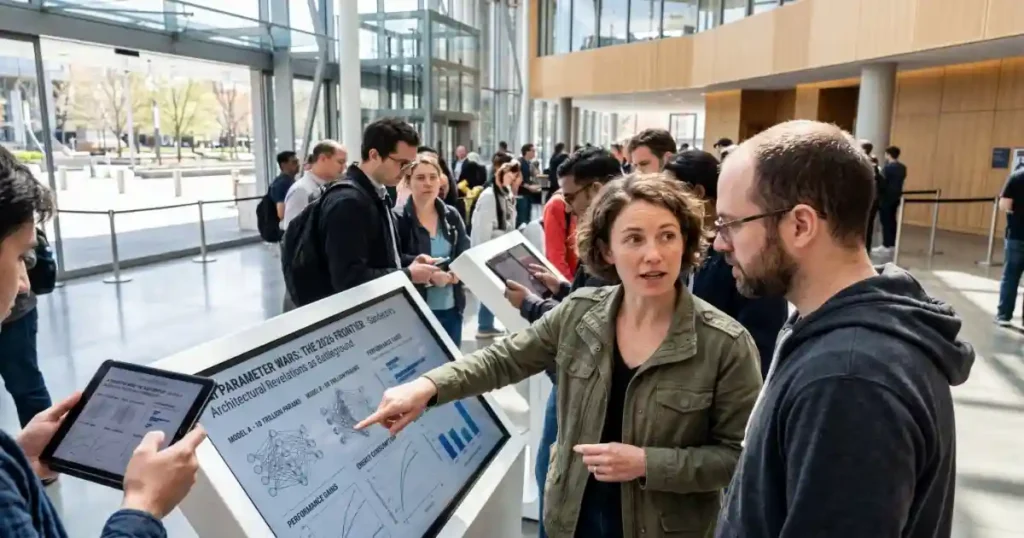
Fast forward to 2026, and Sanderson’s architectural revelations have become the battleground upon which the current AI parameter wars are fought. From the hyper-efficient knowledge distillation models of 2025 to the LLM Optimization (LLMO) strategies dominating corporate marketing today, the mechanics of machine memory have reshaped the technology sector.
The Anatomy of Machine Memory: Decoding the 3Blue1Brown Masterclass
To understand the AI landscape of 2026, we must first decode how these systems process reality. Before Sanderson’s Chapter 7 deep-dive, popular discourse assumed that an LLM’s “Attention Mechanism”—the revolutionary concept introduced in the 2017 “Attention Is All You Need” paper—was the sole magic behind AI comprehension.
However, the 3Blue1Brown investigation clarified a vital distinction: while attention layers are exceptional at moving context around and understanding the relationships between words in a prompt, they are not the primary repositories of factual knowledge. The true encyclopedic memory of an LLM lies within the Feed-Forward layers, also known as Multi-Layer Perceptrons (MLPs).
These MLP layers act as a sprawling, distributed memory bank. Out of the 175 billion parameters in legacy models like GPT-3, the vast majority are dedicated to these feed-forward matrices. When you ask an LLM a question, the input is transformed into a highly dimensional vector.
The MLP layers essentially apply a sequence of massive matrix multiplications to this vector, acting as a complex series of “question-answer” pairs. As the vector passes through the MLP, the model asks mathematical questions of the data. For instance, if the context points to “Michael Jordan,” the weights within the MLP are calibrated to amplify the vector for “basketball”.
Crucially, there is no single “database row” or isolated neuron that stores this fact. Instead, the knowledge is superimposed and distributed across millions of parameters. The model learns these associations during its training phase, absorbing billions of co-occurrences until the weights are finely tuned to output the correct factual association probabilistically.
This diffuse storage mechanism explains both the miraculous recall of modern LLMs and their notorious tendency to hallucinate. If a fact is not deeply etched into the MLP weights during training, the mathematical retrieval process will confidently output a plausible, yet entirely fabricated, association.

The 2025 Distillation Pivot: When Smaller Became Smarter
By early 2025, the AI industry faced a severe economic reality. Running massive 175-billion-parameter models for every minor query was financially unsustainable and computationally wasteful. If facts were stored in these gargantuan MLP matrices, the energy cost of performing billions of mathematical operations for a simple task was crippling.
This bottleneck birthed the “Distillation Revolution,” a period defined by the rapid rise of mini LLMs. OpenAI‘s release of GPT-4o-mini and subsequent distilled models proved that you did not need a leviathan to recall accurate facts. Knowledge distillation is an elegant process where a massive “teacher” model transfers its refined factual pathways to a much smaller, highly efficient “student” model.
Instead of forcing the student model to read the entire internet from scratch, researchers trained the smaller architecture to mimic the exact outputs and latent representations of the teacher’s MLP layers. The result was staggering. Companies could now send API requests in bulk at a fraction of the cost, maintaining the bulk of the larger model’s accuracy.
A prime example of this paradigm shift was documented by legal tech firm Darrow AI. They reported that adopting distilled models allowed them to conduct complex legal research at an unprecedented scale, processing hundreds of thousands of queries monthly.
Because the critical legal facts were successfully compressed into the smaller MLP parameters, the mini models were up to 2.5 times faster than their full-sized predecessors, democratizing access to high-tier legal intelligence without exorbitant cloud computing costs.
Beyond Brute Force: The Compute-Optimal Frontier of 2026
As we navigate 2026, the brute-force scaling era—characterized by the blind assumption that simply adding more parameters would yield vastly superior intellect—has officially hit a wall. Industry analysts now frequently refer to the “Compute-Optimal Frontier“. This concept outlines a strict mathematical threshold where increasing the sheer size of an MLP layer begins to yield severely diminishing returns in factual accuracy and reasoning capabilities.
The realization that you cannot simply buy your way to a smarter AI by expanding its memory matrices has forced leading AI labs to innovate fundamentally. Rather than inflating the parameter count, 2026’s state-of-the-art models rely on superior data curation and “manifold learning” techniques that organize factual knowledge more logically within the existing weights.
It is no longer about how many facts you can cram into a neural network, but how efficiently those facts are structured and retrieved. This shift in philosophy is vividly illustrated by the rise of highly optimized models. In early 2026, models like Qwen have challenged and in some benchmarks surpassed legacy tech giants, proving that an incredibly well-structured embedding space can outperform an unorganized, bloated parameter set.
The focus has moved from gross parameter volume to the “signal-to-noise ratio” of the training data embedded within the Multi-Layer Perceptrons.

Agentic AI and the Zero-Hallucination Mandate
The stakes for factual storage have never been higher than they are today. According to a comprehensive February 2026 report by Turing, the defining trend of the current year is “Agentic AI”—systems designed to make decisions, interact with external tools, and execute actions without ongoing human supervision.
Gartner’s current projections indicate that by 2028, 33% of enterprise applications will feature autonomous agents, completely automating 15% of daily corporate work decisions. For an autonomous agent to execute a multi-step financial transaction or schedule a critical medical procedure, “close enough” is no longer an acceptable standard for factual recall.
The introduction of reasoning-focused architectures, starting with OpenAI’s o1 model in late 2024 and reaching maturity in 2026, shifted the paradigm toward “chain-of-thought” processing. These systems pause to reason through a problem before acting, which requires them to repeatedly pull accurate facts from their MLP layers to construct a logical argument.
If an LLM’s feed-forward layers contain conflicting weights or fuzzy memory associations, the resulting hallucination isn’t just a funny chatbot error; it is a critical system failure. Consequently, the engineering of LLMs in 2026 involves aggressive fact-checking protocols during the reinforcement learning phase, ensuring that the model’s internal representations are definitively aligned with objective truth before they are allowed to operate autonomously in the wild.
The Cultural Shift: Generative Engine Optimization (LLMO)
Perhaps the most fascinating consequence of understanding how LLMs store facts is how human society has adapted to manipulate it. Because researchers (like Sanderson) demystified the matrix multiplications that dictate AI memory, digital marketers and content creators in 2026 have abandoned traditional Search Engine Optimization (SEO) in favor of Large Language Model Optimization (LLMO).

A mid-2025 guide by Wellows detailed how modern content teams are actively reverse-engineering the feed-forward layers of AI models. They discovered that LLMs prioritize context-rich, highly structured semantic clusters when committing facts to their weights. Instead of spamming single keywords to trick a Google algorithm, 2026’s digital strategists use Generative Engine Optimization (GEO) to surround their brand names with high-trust entities and adjacent queries.
By formatting data precisely the way an MLP naturally encodes information, brands are essentially hypnotizing the AI into memorizing their specific narratives as objective facts. The Wellows study noted that AI-generated summaries are now the prime real estate of the internet, with user-generated platforms seeing up to a 603% increase in organic visibility because LLMs trust their consensus-based structures.
We are no longer just writing for human readers; we are architecting our digital reality to be seamlessly ingested into the distributed memory weights of artificial minds.
The True Value of the Ethereal Weights
From a brilliant 3Blue1Brown mathematical visualization to the sprawling autonomous agents of 2026, the journey of understanding how Large Language Models store facts is the defining technological narrative of our decade. We have moved past the initial magic trick of human-like text generation, entering an era of rigorous optimization, knowledge distillation, and agentic reasoning.
The Multi-Layer Perceptron is no longer just a theoretical concept in deep learning textbooks; it is the foundational memory bank of modern civilization. As we continue to push the boundaries of the compute-optimal frontier, the objective remains clear. The future of AI does not belong to the model with the most parameters, but to the system that can map the complex tapestry of human knowledge with the highest fidelity.
In the invisible spaces between digital neurons, the facts that govern our 2026 world are written in the quiet, absolute language of mathematics.