


Navigating a Delicate Economic Balance
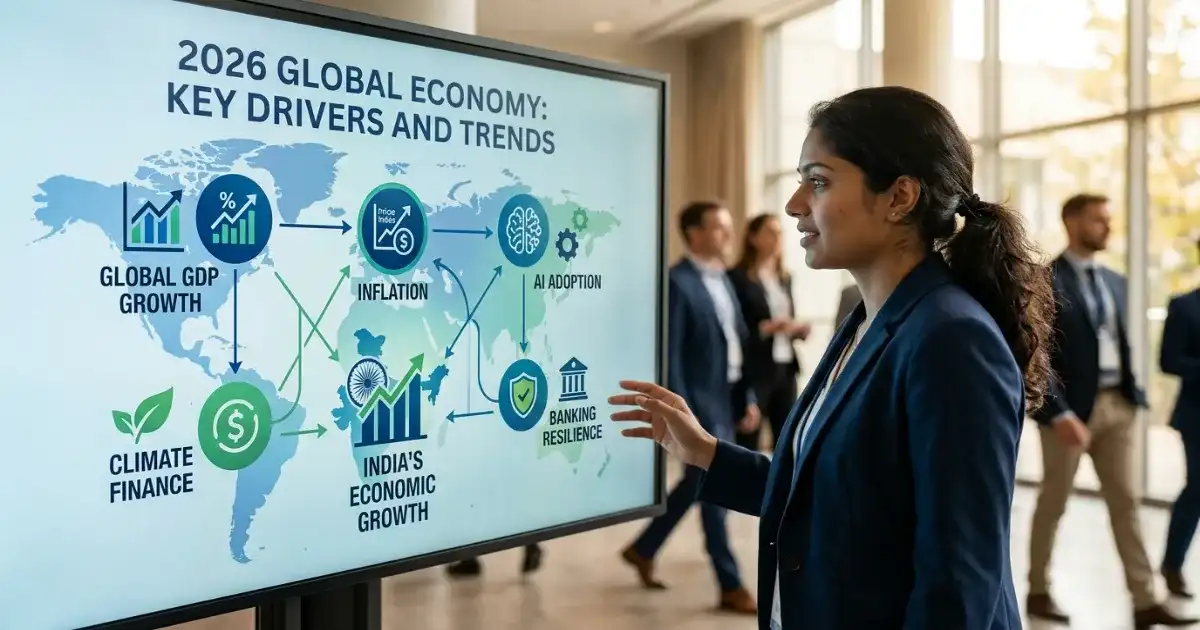
The global financial landscape in 2026 finds itself navigating a delicate equilibrium [1.1.4]. Central banks have prioritized financial resilience as they manage persistent core inflation and geopolitical uncertainties, including the localized conflicts in the Middle East that have disrupted commodity channels.
Concurrently, technological tailwinds—specifically the massive wave of enterprise generative AI and rapid growth in key emerging markets like India—are acting as vital stabilizers. This comprehensive outlook evaluates the current state of banking stability, evolving climate risk frameworks, India’s standout economic performance, and the structural integration of autonomous AI systems.
Global Economy Snapshot
To establish context, the following metrics capture the macroeconomic status of the global economy in mid-2026. This snapshot reflects the latest revisions from international bodies like the International Monetary Fund (IMF) and the World Bank. | Metric | 2026 Status | Underlying Driver | | Global GDP Growth | 3.1% (IMF) / 2.5% (World Bank) |
Geopolitical friction countered by tech spending | | Inflation Outlook | 4.4% (Global Headline) | Resilient labor markets and sticky energy prices | | Interest Rates | Elevated | Central banks preserving restrictive policies | | AI Adoption | Rapid Scale-Up | Shifting from pilot projects to agentic deployments | | Banking Stability | Strong | Robust capital ratios validated by stress tests | | Climate Finance | Expanding | Standardized disclosure mandates taking effect |
| Economy | GDP Growth | Inflation | Key Driver |
|---|---|---|---|
| USA | Moderate | Sticky | AI Investment |
| India | High | Stable | Domestic Demand |
| China | Moderate | Low | Manufacturing |
| EU | Slow | Moderate | Green Transition |
Federal Reserve Stress Tests: Reassurance for the Banking Sector
In late June 2026, the Federal Reserve released the highly anticipated results of its annual bank stress tests. This comprehensive exercise evaluated the resilience of 32 of the nation’s largest financial institutions under a severely adverse hypothetical scenario.
The simulated crisis modeled a ‘real estate Armageddon,’ featuring a 39% plunge in commercial real estate (CRE) prices, a 30% drop in residential housing, a sharp spike in unemployment to 10%, and a severe contraction in global economic output.


The results brought widespread reassurance across Wall Street. Aggregate Common Equity Tier 1 (CET1) capital declined by only 1.6 percentage points, with all participating institutions remaining well above their regulatory minimum capital requirements.
Despite absorbing over $708 billion in hypothetical total losses—including $200 billion in credit card losses, $160 billion in commercial and industrial loans, and $75 billion in CRE losses—the banking system proved highly resilient.
Following the release of these results, major financial institutions announced substantial dividend increases. For example, Citigroup declared a 12% boost in its quarterly dividend and continued its massive multi-year share buyback program.
However, regulators caution that these tests should not be interpreted as a green light to lower capital requirements. Persistent elevated interest rates and continuing structural adjustments in office-space valuations demand ongoing vigilance, ensuring that banks maintain conservative buffers.
Climate Risks and Financial Stability: A New Regulatory Mandate
Long-term financial stability in 2026 is increasingly viewed through the lens of environmental resilience. The Financial Stability Board (FSB) and the IMF have shifted focus from qualitative recommendations to concrete supervisory frameworks.
Regulators are actively addressing both physical risks, such as extreme weather events causing localized asset write-downs, and transition risks, which emerge during the global pivot toward a carbon-neutral economy.
Central banks are now integrating climate scenarios into their standard stress-testing toolkits. These exercises evaluate how sudden shifts in carbon pricing or rapid physical damage affect banking balance sheets.
To mitigate transition risks and capitalize on sustainable growth, financial institutions are channeling unprecedented volumes of capital into renewable energy portfolios, particularly those focusing on groundbreaking technological advancements.
At the same time, banks are structuring specialized green loan facilities to support next-generation storage solutions. These capital reallocations are essential for transitioning heavy industry toward sustainable baseload power, ensuring that financial systems remain insulated from fossil-fuel asset stranded risks.(Solid-State Batteries)
India’s Growth Story: The Engine of Global Expansion
India continues to establish itself as the premier growth engine of the global economy in 2026. According to the IMF’s latest World Economic Outlook, India is projected to grow at a robust rate of 6.5%, contributing a commanding 17.2% to global GDP growth this year and outperforming other major economies.
Concurrently, the World Bank’s India Development Update forecasts a 6.6% expansion for the fiscal year, highlighting the country’s superior macroeconomic resilience despite persistent global headwinds.

India’s stellar economic performance is anchored by strong policy buffers, including substantial foreign exchange reserves, low and manageable inflation, and predominantly rupee-denominated public debt. Furthermore, the government’s aggressive capital expenditure on physical and digital public infrastructure has unleashed immense productivity across both rural and urban markets.
The nation is also positioning itself as a leader in industrial modernization, leveraging advanced operational paradigms to optimize supply chains and streamline heavy manufacturing. By adopting human-centric technological systems, Indian companies are enhancing factory-floor safety and efficiency. Read Also: Industry 5.0
To achieve its ‘Viksit Bharat’ development objectives by mid-century, India is focusing heavily on creating a business-enabling regulatory environment. This includes integrating sophisticated modeling tools to optimize large-scale logistics and urban planning projects. Read Also: Digital Twin Technology
AI Transforming Financial Systems: Moving From Pilots to Scale
Artificial Intelligence in 2026 has transitioned from localized pilot projects to the primary operating layer of global financial systems. Gartner reports that global AI spending has reached $2.5 trillion, with banking institutions spearheading the deployment of ‘agentic AI’.
These are autonomous, specialized AI agents capable of executing multi-step compliance, underwriting, and risk-management workflows.
The financial returns are already immense. JPMorgan Chase generates between $1.5 billion and $2 billion in annual business value from over 450 active AI use cases, while Bank of America has prevented billions in fraud through real-time machine learning.
Additionally, global banks are leveraging AI to automate labor-intensive processes, restructuring their service delivery and streamlining lending operations from end to end.
To sustain this computational revolution, the financial sector is exploring advanced physical architectures to secure data flows and perform complex risk simulations. This includes investigating next-generation security and computing platforms to protect highly sensitive transaction records. (Quantum Computing)
Future Outlook: The Long-Term Macroeconomic Horizon
Looking ahead toward the late 2020s, the global economy is expected to navigate a path of cautious stabilization. The convergence of deep technology and capital markets will continue to accelerate, prompting a complete redesign of legacy financial architectures.
Regulatory agility will remain paramount in ensuring that this rapid adoption does not introduce systemic vulnerabilities. Ultimately, the transition toward a sustainable, tech-driven economic model will require resolving the global energy demand.
As clean energy technologies mature, the financial sector is turning its eye toward highly advanced, long-term power generation methods that could permanently solve the world’s energy challenges. Read Also: Fusion Energy.
Key Takeaways
✔ Global banking remains resilient
✔ AI is reshaping financial services
✔ Climate finance is becoming mainstream
✔ India remains fastest growing major economy
✔ Central banks continue fighting inflation
Frequently Asked Questions (FAQs)
1. What is the projected global GDP growth rate for 2026?** The IMF projects global GDP growth to reach 3.1% under its reference forecast, while the World Bank projects a slightly more conservative rate of 2.5%, reflecting ongoing geopolitical tensions.
2. Did U.S. banks pass the 2026 Federal Reserve stress tests? Yes, all 32 participating major U.S. banks passed the 2026 stress tests, demonstrating strong capital buffers capable of absorbing over $708 billion in hypothetical losses.
3. What was the hypothetical scenario used in the 2026 Fed stress tests?** The scenario simulated a severe global recession featuring a 39% decline in commercial real estate prices, a 30% drop in home prices, and a spike in unemployment to 10%.
4. How is India’s economy performing in 2026?** India remains the fastest-growing major economy, with the IMF projecting 6.5% growth and the World Bank forecasting 6.6% for the fiscal year, driven by strong macroeconomic fundamentals.
5. How much is India contributing to global GDP growth in 2026?** According to the IMF, India is projected to contribute 17.2% of global GDP growth in 2026, surpassing the United States.
6. What are the main financial risks associated with climate change in 2026?** The primary risks are physical risks (asset damage from extreme weather) and transition risks (financial losses from shifting away from carbon-intensive industries).
7. How are global banks leveraging AI in 2026?
Banks are deploying autonomous AI agents for hyper-personalized banking, automated fraud detection, algorithmic trading, and streamlining compliance operations.
8. What is ‘agentic AI’ in the context of banking?
Agentic AI refers to autonomous, goal-oriented AI agents that can execute multi-step workflows, such as processing loan applications or managing portfolio risk, without constant human intervention.
9. Why are interest rates expected to remain elevated in 2026?** Central banks are keeping interest rates elevated to curb persistent core inflation driven by supply chain shifts and geopolitical tensions in the Middle East.
10. What long-term technologies are expected to reshape the future financial outlook?** Technologies such as Green Hydrogen, Quantum Computing, Solid-State Batteries, and Fusion Energy are expected to drive the transition to a sustainable, hyper-efficient global economy.
Conclusion
In conclusion, the 2026 global economic outlook is defined by a compelling interplay between defensive resilience and bold technological innovation. While geopolitical conflicts in the Middle East and persistent interest rate pressures present ongoing headwinds, the foundational stability of the banking sector ensures that systemic crises remain contained.
Concurrently, India’s remarkable growth story highlights the shifting centers of global economic gravity, while the rapid maturity of agentic AI and climate finance frameworks offers a structured blueprint for future prosperity.
For financial institutions and policy leaders, the path forward requires a balanced commitment to strict risk management, technological adoption, and environmental sustainability.