
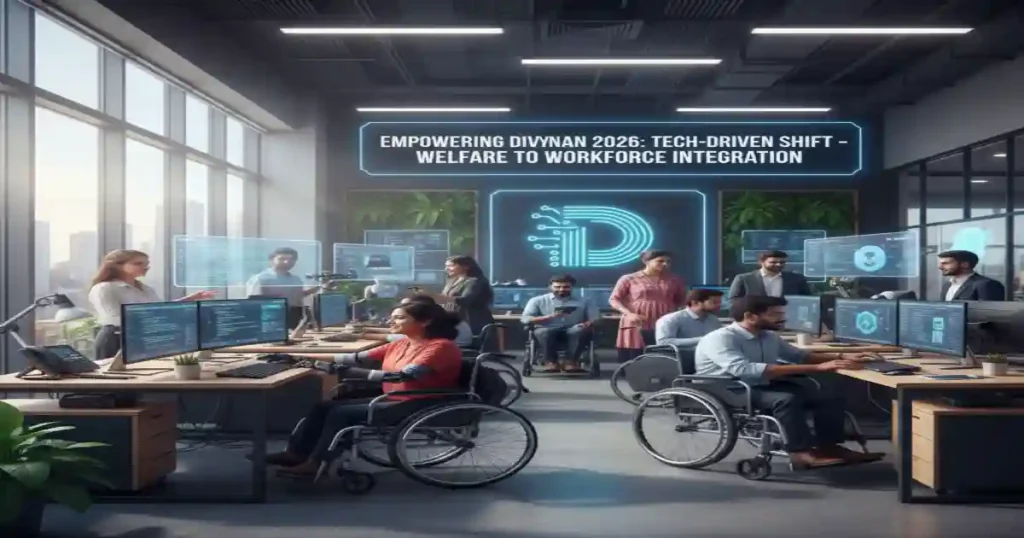


The Paradigm Shift in Divyangjan Empowerment
The conceptualization of disability in India has undergone a profound and necessary evolution over the past decade. The term ‘Divyangjan’—translating roughly to ‘individuals with divine bodies’—was coined to replace derogatory or purely clinical terminology, sparking a cultural shift that aimed to recognize the inherent potential of persons with disabilities (PwDs).
However, as policymakers and social advocates soon realized, linguistic dignity must be backed by infrastructural, economic, and technological enablement. For decades, India’s approach to its differently-abled population, which numbers over 26 million according to official estimates, was fundamentally rooted in a welfare paradigm.
The narrative was largely centered around social protection, nominal disability pensions, and charitable assistance. While these measures provided a baseline safety net, they inherently limited the aspirations of Divyangjan, treating them as passive recipients rather than active architects of the nation’s economy.
Fast forward to early 2026, and the socio-economic landscape for Divyangjan has been entirely reimagined. The discourse has decidedly pivoted from ‘welfare’ to ‘workforce integration,’ and from ‘assistance’ to ‘autonomy’. The Government of India, spearheaded by the Department of Empowerment of Persons with Disabilities (DEPwD), is recognizing that genuine empowerment is achieved when systemic barriers are dismantled, allowing PwDs to participate freely in Industry 4.0.
This transformative vision requires a multi-pronged approach: equipping Divyangjan with highly relevant modern skills, democratizing access to cutting-edge assistive technologies, and enforcing the architectural tenets of universal design across the country.
As of March 2026, the legislative and budgetary frameworks have finally caught up with this modern ethos. The government has discarded the one-size-fits-all model of vocational training and is now aggressively pursuing precision-skilling initiatives.
Through a synergy of public policy, private sector engagement, and artificial intelligence integration, India is laying down the comprehensive groundwork necessary to ensure that its Divyangjan population becomes a crucial demographic dividend in the nation’s overarching journey toward becoming a developed economy (‘Viksit Bharat’) by 2047.
The Union Budget 2026-27: A Watershed Moment for Inclusion
The turning point for this new era of inclusivity was unequivocally marked on February 1, 2026, with the presentation of the Union Budget 2026-27. Finance Minister Nirmala Sitharaman unveiled transformative measures that drew widespread acclaim from the disability sector, including peak advocacy bodies like the National Centre for Promotion of Employment for Disabled Persons (NCPEDP).
Under the guiding principle of ‘Sabka Saath, Sabka Vikas’ (Inclusive Development for All), the budget formally institutionalized the transition from traditional charity to aggressive economic enablement. The fiscal blueprint introduced two flagship initiatives specifically designed for Divyangjan empowerment: the Divyangjan Kaushal Yojana and the Divyang Sahara Yojana, supported by a dedicated combined allocation of ₹300 crore.
This budgetary allocation is not merely a financial provision; it is a structural acknowledgment that persons with disabilities require bespoke economic pathways. Historically, funding for the disability sector has often been diluted through broad social justice schemes. By carving out specific, heavily-funded verticals targeting high-end skilling and advanced manufacturing, the Union Budget 2026 signals a definitive commitment to specialized intervention.
The NCPEDP hailed these announcements as a “timely and much-needed intervention” that harmonizes seamlessly with long-standing demands to merge assistive technology with robust livelihood creation. This strategic investment guarantees that empowerment is measurable, outcome-oriented, and firmly aligned with the demands of a modern, digitized global economy.


Divyangjan Kaushal Yojana: Skilling for Industry 4.0
At the heart of the government’s employment generation strategy is the Divyangjan Kaushal Yojana. Allocated ₹200 crore for the upcoming fiscal year, this scheme fundamentally disrupts the antiquated model of disability vocational training. In the past, skill development for Divyangjan was frequently relegated to low-income, informal trades that offered minimal upward mobility and virtually no integration with the corporate sector.
The Kaushal Yojana shatters this ceiling by focusing exclusively on industry-relevant, high-growth sectors. The curriculum is specifically curated to train individuals in Information Technology (IT), Animation, Visual Effects, Gaming, and Comics (AVGC), alongside specialized roles in modern hospitality and food & beverage management.
The rationale behind selecting these specific sectors is deeply rooted in modern workplace dynamics. As highlighted during the Budget presentation, these fields offer “task-oriented and process-driven roles” that are highly compatible with the functional needs of various disability groups. For instance, the AVGC and IT sectors heavily favor remote work, asynchronous communication, and output-based performance metrics.
This aligns perfectly with the accommodations often required by individuals with mobility constraints or neurodivergent conditions. By pivoting Divyangjan into the formal, digital gig economy, the scheme ensures dignified, sustainable livelihood opportunities. Furthermore, the training is explicitly tailored; there is no generic syllabus.
Instead, modules are customized according to the specific cognitive and physical requirements of different Divyang groups, ensuring that the training is both accessible and highly effective. During a massive Post-Budget Webinar hosted by the DEPwD on March 9-10, 2026, industry leaders and policymakers heavily scrutinized the implementation of this scheme. The consensus was clear: to maximize the impact of the Divyangjan Kaushal Yojana, the skilling ecosystem must remain strictly demand-driven.
This involves integrating PwDs deeply into mainstream STEM learning ecosystems, fostering inclusive corporate hiring practices, and establishing robust, AI-enabled remote working platforms. The ultimate goal is not merely employment, but the creation of a highly competitive talent pool that domestic and international corporations actively seek out.
Divyang Sahara Yojana: Democratizing Assistive Technology
Parallel to the push for intellectual empowerment is the critical need for physical enablement. The Divyang Sahara Yojana, bolstered by a ₹100 crore budget, serves as the technological backbone of the 2026 inclusion strategy. For years, a major hurdle for Divyangjan in India has been the prohibitive cost and limited availability of high-quality assistive devices.
Advanced prosthetics, smart wheelchairs, and digital accessibility tools were largely imported, rendering them unaffordable for the masses. The Sahara Yojana aims to reverse this by turning India into a global hub for affordable, high-tech assistive technology manufacturing under the ‘Make in India’ framework.
The central pillar of this scheme is the massive scaling and modernization of the Artificial Limbs Manufacturing Corporation of India (ALIMCO), a critical Central Public Sector Undertaking. The government is infusing capital directly into ALIMCO’s Research and Development (R&D) wings to integrate Artificial Intelligence into their product lines.
This translates to the domestic production of myoelectric prosthetic hands that respond to nerve signals, AI-integrated smart limbs that adapt to user gait, motorized wheelchairs equipped with spatial awareness sensors, and advanced e-Braille readers. By bringing these advanced technologies onto Indian soil, the cost barrier is dramatically reduced, allowing PwDs from lower-economic backgrounds to access tools previously reserved for the elite.
Grassroots Delivery: PM Divyasha Kendras and Assistive Tech Marts
While manufacturing advanced equipment is crucial, the delivery mechanism dictates the ultimate success of the policy. The Sahara Yojana addresses this through the establishment and strengthening of PM Divyasha Kendras. These are conceptualized as hyper-local, integrated hubs providing end-to-end services under a single roof.
Rather than navigating a labyrinth of bureaucratic offices, a Divyang individual can visit a PM Divyasha Kendra for professional medical assessment, evaluation, device customization, counseling, distribution, and essential post-distribution maintenance care. This holistic approach ensures that the assistive devices remain functional and optimized for the user long after the initial fitting.
An even more revolutionary concept introduced in the 2026 Budget is the creation of ‘Assistive Technology Marts’. Historically, acquiring disability aids has been a clinical, often sterile process. The Assistive Technology Marts completely re-envision this experience.
Designed as modern, retail-style experiential centers, these hubs will allow Divyangjan and senior citizens to browse, interact with, test, and purchase assistive products in a dignified, highly accessible, user-friendly environment. This shift from a ‘dispensary’ mindset to an empowered ‘consumer’ mindset restores agency and choice to persons with disabilities, marking a profound psychological shift in how accessibility is delivered in India.

State-Level Administrative Innovation: The UP Divyangjan Rozgar Abhiyan Model
National policies formulate the vision, but state-level administrative ingenuity executes the reality. One of the most striking examples of this execution taking place in 2025 and early 2026 is the Divyangjan Rozgar Abhiyan in Uttar Pradesh.
Recognizing the persistent gap where acquired skills do not seamlessly translate into jobs, the Uttar Pradesh Skill Development Mission (UPSDM) launched a massive, structured statewide effort explicitly for the differently-abled. Conceived and championed by IAS officer Pulkit Khare, this initiative bypassed the bureaucratic lethargy of routine schemes by operating as a high-intensity, mission-mode campaign.
The Divyangjan Rozgar Abhiyan focuses purely on the endpoint: employment and entrepreneurship. During its initial rollout phases spanning late 2025 into 2026, the administration mobilized district-level coordination across major hubs like Lucknow, Kanpur Nagar, and Varanasi. Through rigorous monitoring and aggressive corporate tie-ups, the campaign achieved staggering success, successfully connecting nearly 1,900 trained Divyang youths to viable livelihood opportunities and facilitating true financial independence.
This initiative highlights that an empowered, sensitized bureaucracy can force-multiply policy intent. As India struggles with ensuring workforce participation for its millions of PwDs, the UP Divyangjan Rozgar Abhiyan is rapidly emerging as the gold-standard blueprint, proving that targeted administrative campaigns can be replicated nationally to bridge the gap between skilling and hiring.
Youth Participation and Policy: The Breaking Barriers Fellowship 2026
Sustained inclusion cannot be achieved in a vacuum; it requires a continuous influx of fresh perspectives and empathetic leadership. Recognizing this, a landmark initiative was launched in January 2026: The Breaking Barriers Fellowship.
Forged through a powerful collaboration between Young Leaders for Active Citizenship (YLAC), the Nipman Foundation, the India Autism Center, the DEPwD, and the United Nations, this fellowship is a masterclass in participatory governance. It represents a structural effort to embed passionate young professionals directly into the public systems that dictate disability governance.
The first cohort of ten Fellows has been placed within pivotal national institutions, including the Office of the Chief Commissioner for Persons with Disabilities, the National Trust, and the Rehabilitation Council of India. These young leaders work shoulder-to-shoulder with senior bureaucrats to streamline policy processes, enforce the stipulations of the Rights of Persons with Disabilities (RPwD) Act 2016, and provide vital research inputs.
As noted by Manmeet Nanda, Joint Secretary at DEPwD, breaking physical barriers is only part of the equation; breaking societal, mental, and institutional barriers requires institutionalized empathy. By bridging the gap between dynamic youth advocates and institutional mechanisms, the Breaking Barriers Fellowship ensures that India’s disability policies remain progressive, modern, and fiercely aligned with global human rights standards.
Universal Design: Reimagining Public Infrastructure
Employment and technological empowerment lose their efficacy if a Divyang individual cannot physically navigate their city. Under the Accessible India Campaign, India is executing one of the highest-intensity infrastructural retrofitting operations in the developing world. The conversation has matured far beyond merely installing ramps at building entrances.
Today, the focus is squarely on ‘Universal Design’—the creation of environments inherently accessible to all people, regardless of age, size, or ability. Recent data from early 2026 highlights the success of these mandates, with over 1,030 Central Government buildings having undergone full accessibility retrofits.
Furthermore, the government has recalibrated its focus toward ‘end-to-end’ connectivity, particularly prioritizing the critical arteries of the railway and aviation sectors. The modern infrastructure mandate requires tactile paths for the visually impaired, ambulatory lifts, deeply integrated digital wayfinding, and universally accessible sanitation facilities.
This shift is philosophical as much as it is physical; it is about ensuring dignified, independent travel rather than assisted movement, empowering PwDs to navigate the public sphere without relying on charitable intervention.
Synergizing Stakeholders: The Power of Jan Bhagidari
The sheer scale of India’s disability empowerment roadmap necessitates an all-hands-on-deck approach. The government’s push to accelerate these initiatives was on full display during the extensive Post-Budget Webinars held on March 9 and 10, 2026. Addressing the nation, Prime Minister Narendra Modi reiterated that India’s aspirations are intricately linked to the optimal utilization of its human capital, emphatically bringing Divyang youth into the fold of the nation’s “greatest strength”.
He lauded the webinar series as a profound exercise in Jan Bhagidari—participatory governance—where lakhs of stakeholders, from grassroots beneficiaries to top-tier industry executives, converged to hash out actionable strategies for implementing the new schemes.
The breakout sessions, specifically curated by the DEPwD, delved into the intricacies of integrating market-linked skill programs, promoting accessible training tools, and fostering inclusive corporate hiring practices. Union Minister for Social Justice and Empowerment, Dr. Virendra Kumar, encapsulated the mood perfectly, stating that a nation’s genuine progress is measured strictly by how effectively it empowers its most vulnerable citizens.
By facilitating direct dialogue between the state apparatus and the corporate ecosystem, the government is ensuring that the Divyangjan Kaushal Yojana and Sahara Yojana do not remain confined to paper, but swiftly translate into measurable socio-economic mobility.
The Path Forward: Sustaining Momentum Towards 2047
As India positions itself on the global stage as a burgeoning superpower, the holistic empowerment of Divyangjan is not merely a moral imperative, but an unignorable macroeconomic necessity. The sweeping developments of 2026—from the visionary budget allocations to the AI-driven tech leaps and grassroots employment campaigns—demonstrate a mature, comprehensive strategy.
Beyond direct employment, the state is also cultivating a vibrant class of ‘Divyang’ entrepreneurs through robust financial mechanisms. By early 2024, the National Divyangjan Finance and Development Corporation (NDFDC) had already disbursed over ₹1,330 crore in microfinance, a figure expected to multiply exponentially as the new budget measures take root.
The road ahead requires relentless momentum. The execution of the Divyangjan Kaushal and Sahara Yojanas must be meticulously tracked, ensuring zero leakage and maximum grassroots penetration. Corporate India must move beyond statutory CSR obligations and recognize PwDs as highly focused, capable, and loyal talent resources.
By sustaining this tech-driven, rights-based, and employment-focused ecosystem, India is doing much more than providing aid; it is meticulously building an egalitarian society where every Divyangjan is acknowledged as an indispensable pillar of the nation’s future.