
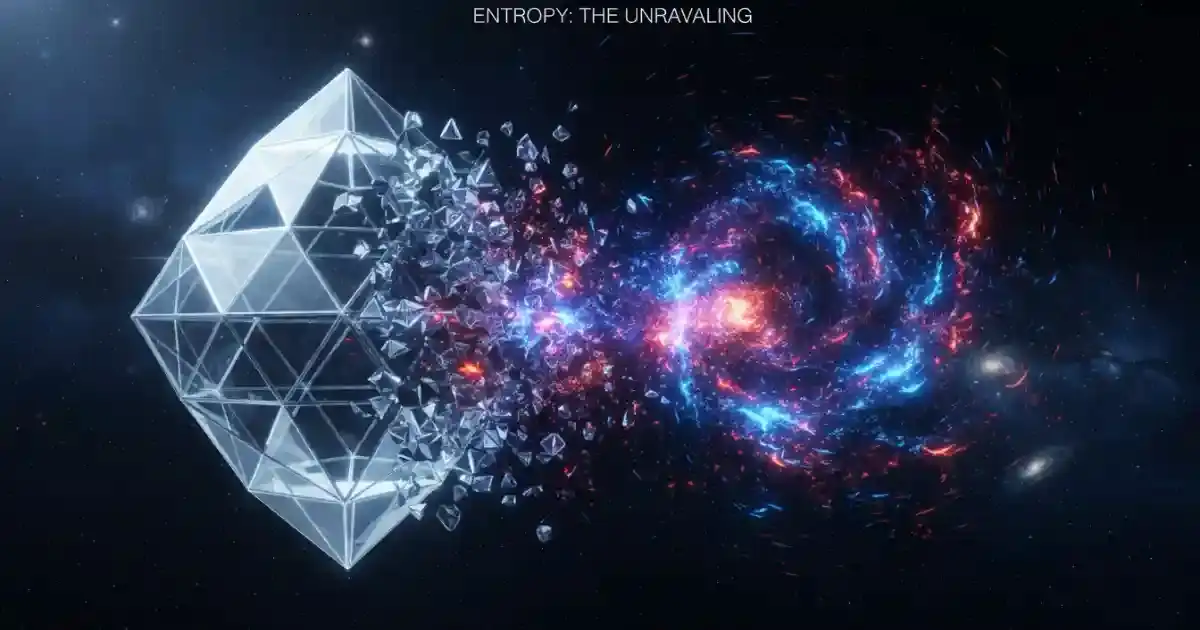
7 Mind-Blowing Facts About Entropy: Why the Universe Demands Disorder
7 Mind-Blowing Facts About Entropy: Why the Universe Demands Disorder

The Paradox of Sunlight: What Does Earth Actually Get?
Ask a room full of people what the Earth receives from the Sun, and the unanimous answer will be ‘energy.’ It seems obvious. The Sun shines, plants grow, oceans warm up, and solar panels generate electricity. But from a physicist’s perspective, this answer is fundamentally incomplete—and arguably wrong.
If the Earth merely received energy without releasing it, the planet would eventually become molten hot. In reality, the Earth radiates almost exactly as much energy into space as it absorbs from the Sun. So, if the net energy balance is zero, what is driving life? The answer lies not in the *quantity* of energy, but in its *quality*.
The Sun sends us energy in a highly concentrated, low-entropy form (visible light). The Earth uses this energy to do work—photosynthesis, weather patterns, cellular respiration—and then radiates it back out into the cosmos as high-entropy waste heat (infrared radiation). We aren’t running on energy; we are running on the flow of entropy.
We are riding a wave of order turning into disorder. This realization unlocks the true meaning of the most misunderstood concept in physics: Entropy.

1. The Steam Engine Origins: How Carnot Discovered the Limit
Before entropy was a statistical concept, it was an engineering headache. In the early 19th century, the Industrial Revolution was powered by steam. Engineers were obsessed with building better, more efficient engines. Enter Sadi Carnot, a young French military engineer who, in 1824, stumbled upon a fundamental truth that would govern the universe.
Carnot realized that a steam engine’s efficiency didn’t just depend on the mechanical design, but on the temperature difference between the heat source and the heat sink. Carnot discovered that you can never convert 100% of heat energy into work. There is always a tax.
Energy inevitably wants to spread out. When heat flows from a hot boiler to a cool condenser, it can push a piston, but once the temperatures equalize, the work stops. This ‘spreading out’ of energy was the first glimpse of entropy. It wasn’t just a technical limitation; it was a law of nature. Energy is conserved (First Law), but the *usefulness* of that energy constantly diminishes (Second Law).

2. Entropy is Not ‘Disorder’—It’s Probability
The most common analogy for entropy is a messy bedroom. You clean it (add energy), but it spontaneously gets messy again over time. While this helps intuitively, it imprecise. A better definition comes from the Austrian physicist Ludwig Boltzmann. He redefined entropy not as vague ‘disorder,’ but as a precise statistical measure. Imagine a box with gas particles.
There are infinitely more ways for the particles to be scattered randomly throughout the box than there are for them to be clumped neatly in one corner. Boltzmann introduced the concept of *microstates* and *macrostates*. A ‘microstate’ is the specific arrangement of every individual atom. A ‘macrostate’ is the overall appearance (e.g., ‘gas is evenly spread’).
The macrostate ‘evenly spread’ has vastly more corresponding microstates than the macrostate ‘clumped in a corner.’ Therefore, the system moves toward the spread-out state simply because it is statistically more likely. Billions of times more likely. Entropy, denoted as *S*, is defined by the formula engraved on Boltzmann’s tombstone: $S = k \log W$, where *W* is the number of microstates. High entropy essentially means ‘high probability.’

3. The Arrow of Time: Why You Can’t Un-Shatter a Cup
The laws of physics, at the atomic level, are mostly time-symmetric. If you recorded a video of two billiard balls colliding and played it backward, it would look perfectly natural. Newton’s laws work equally well forward and backward. So, why do we perceive time flowing in only one direction?
Why does a dropped coffee cup shatter, but a pile of shards never spontaneously jumps up to form a cup? The answer is the Second Law of Thermodynamics. The shattering of the cup represents a massive increase in entropy. The energy that held the ceramic together is dissipated as sound, heat, and kinetic energy of the shards.
While it is *theoretically* possible for all the air molecules in the room to hit the shards at the exact right angle and speed to reassemble them, the probability is so infinitesimally small that it wouldn’t happen in the lifetime of the universe. The ‘Arrow of Time’ is not a fundamental force; it is a statistical emergence of entropy increasing. The future is simply the direction of higher entropy.

4. Life: The Ultimate Entropy Machine
This brings us back to biology. Living things seem to violate the Second Law. A human body is incredibly ordered, complex, and low-entropy compared to the raw materials (food and water) it consumes. Are we breaking the laws of physics? No. We are paying for our internal order by creating a massive amount of external disorder.
Erwin Schrödinger, in his famous book *What is Life?*, argued that life survives by feeding on ‘negative entropy’ (negentropy). We take in low-entropy packets (sunlight for plants, food for animals) and excrete high-entropy waste (heat, carbon dioxide, feces). The total entropy of the universe—us plus our environment—still increases.
In fact, life is remarkably efficient at dissipating energy. From a thermodynamic standpoint, the purpose of life might just be to speed up the heat death of the universe by degrading energy faster than non-living matter could.
5. The Heat Death: The Universe’s Final State
If entropy is always increasing, where does it end? If you follow the logic to its conclusion, the universe is slowly winding down. Every star that burns, every engine that turns, and every thought you think contributes to the spreading out of energy. Eventually, all energy will be evenly distributed.
There will be no temperature differences to drive work. No stars, no life, just a lukewarm soup of particles hovering near absolute zero. This is known as the *Heat Death of the Universe*. It is a state of maximum entropy. In this state, nothing interesting can ever happen again because ‘interesting’ things require a flow of energy from high to low concentration.
It’s a bleak outlook, but it underscores the preciousness of our current era. We live in a ‘Goldilocks’ phase of the cosmos—after the Big Bang provided a low-entropy start, but before the inevitable equilibrium of the end. We exist solely because the universe is not yet finished shuffling its deck of cards.
6. Information Entropy: The Digital Connection
The concept of entropy extends beyond steam engines and atoms; it powers the digital age. Claude Shannon, the father of information theory, adapted Boltzmann’s formula to measure information. In this context, entropy represents uncertainty. A coin toss has high entropy (you don’t know the outcome), while a coin with two heads has zero entropy (maximum information, zero uncertainty).
This connection is deep. Physicist Rolf Landauer showed that erasing a bit of digital information necessarily releases a tiny amount of heat. This links the abstract world of data directly to the physical world of thermodynamics. Your computer heating up isn’t just electrical resistance; it is the physical cost of manipulating information and reducing local entropy (organizing data) at the expense of the environment.
7. Why the ‘Big Bang’ Was Highly Ordered
For the Second Law to hold true today, the universe must have started in a state of incredibly low entropy. This is one of the biggest unsolved mysteries in cosmology. The Big Bang wasn’t just an explosion of energy; it was an explosion of *order*. If the early universe had been a high-entropy chaotic mess (like a black hole), there would have been no potential for galaxies, stars, or life to form.
Roger Penrose and other cosmologists calculate that the odds of our universe starting in such a low-entropy state by chance are 1 in 10 to the power of 10 to the power of 123. It is a number so large that writing it out would require more zeros than there are atoms in the observable universe. We are still coasting on that initial endowment of order, like a battery that was fully charged 13.8 billion years ago and is slowly draining.
Embracing the Chaos
Entropy is often viewed as a destructive force—the reason things break, rot, and die. But without the tendency of energy to spread out, nothing would ever happen. The flow of entropy is the flow of time itself. It is the river in which we swim. The Sun gives us the high-quality fuel to swim against the current effectively, creating pockets of art, science, and life in a universe drifting toward silence.
So, the next time you feel overwhelmed by the disorder of daily life, remember: you are doing your thermodynamic duty. You are a complex, beautiful swirl in the cosmic coffee cup, existing only because the universe loves to mix. Sadi Carnot’s insight, Entropy is Not ‘Disorder, Erwin Schrödinger, and The Paradox of Sunlight.





Когда вы планируете поездку в Потсдам и хотите узнать, что посмотреть за один день, то стоит обязательно посетить Сан-Суси, Голландский квартал Потсдам и дворец Глиникке. Для почитателей природы и спокойствия отлично станет идеальным японский сад в Дюссельдорфе или путешествие по паркам Германии, таким как лихтенхайнский водопад и крепость Кёнигштайн.
К тому же рекомендую заглянуть на барахолку в Дюссельдорфе — блошиный рынок с занимательными находками по адресу [url=https://holidaygid5.ru]защита окружающей среды в германии[/url] . А если совершаете поездку с детьми, то фантазия ленд даст весёлые аттракционы, расценки на билеты и подробности можно узнать на их главном сайте. Независимо от интересов, Германия богата на достопримечательности, от замков Берлина до экологичных маршрутов немецкой дороги сказок.
Hi Friends,
Thank you for sharing your own experience with dishamunch.com ! I love hearing how different readers adapt recipes and ideas to their own kitchens. Your tip about response is fantastic.
Thanks for contributing your perspective – it adds so much to our community!
– Dr. Pavitra Singh at DISHA (Divyang/disabled Identity Safety Help Association) Munch”
Hi Friends,
Thank you for sharing your own experience with dishamunch.com ! I love hearing how different readers adapt recipes and ideas to their own kitchens. Your tip about response is fantastic.
Thanks for contributing your perspective – it adds so much to our community!
– Dr. Pavitra Singh at DISHA (Divyang/disabled Identity Safety Help Association) Munch”
Hi Friends,
Thank you for sharing your own experience with dishamunch.com ! I love hearing how different readers adapt recipes and ideas to their own kitchens. Your tip about response is fantastic.
Thanks for contributing your perspective – it adds so much to our community!
– Dr. Pavitra Singh at DISHA (Divyang/disabled Identity Safety Help Association) Munch”
Hi Friends,
Thank you for sharing your own experience with dishamunch.com ! I love hearing how different readers adapt recipes and ideas to their own kitchens. Your tip about response is fantastic.
Thanks for contributing your perspective – it adds so much to our community!
– Dr. Pavitra Singh at DISHA (Divyang/disabled Identity Safety Help Association) Munch”
При планировании отдых на озере Шира, рекомендуется заранее продумать о вариантах размещения. Базы на Шира предоставляют разные варианты — от простых домиков до более благоустроенных комплексов с бассейном. К примеру, база отдыха Шира Жемчужный выделяется уютными шира домиками и достойными условиями для семейного отдыха. Для тех, кто разыскивает жилье рядом с природой и привлекательными местами, удачным ориентиром могут стать базы отдыха Шира с бассейном или трехзвездочные базы Шира, а также исключительный сад камней Шира, который обязательно стоит посетить. Детальнее можно изучить на [url=https://rafoto.ru/]отдых на шира[/url] .
Если приоритетна цена и комфортное расположение, то база отдыха Жемчужный Шира является отличным выбором — здесь зачастую можно найти предложения шира жемчужный снять домик по разумной цене. Энтузиасты каякинга и водных видов спорта наверняка оценят катекс Шира и бегущую по волнам Ширу как аспект активного озеро Шира отдых. Поэтому, если хотите провести шира отдых, нужно тщательно отобрать базу отдыха на Шира и заранее бронировать жильё, чтобы устроить комфортное и приятное время.
Hi Friends,
Thank you for sharing your own experience with dishamunch.com ! I love hearing how different readers adapt recipes and ideas to their own kitchens. Your tip about response is fantastic.
Thanks for contributing your perspective – it adds so much to our community!
– Dr. Pavitra Singh at DISHA (Divyang/disabled Identity Safety Help Association) Munch”
Hi Friends,
Thank you for sharing your own experience with dishamunch.com ! I love hearing how different readers adapt recipes and ideas to their own kitchens. Your tip about response is fantastic.
Thanks for contributing your perspective – it adds so much to our community!
– Dr. Pavitra Singh at DISHA (Divyang/disabled Identity Safety Help Association) Munch”
Hi Friends,
Thank you for sharing your own experience with dishamunch.com ! I love hearing how different readers adapt recipes and ideas to their own kitchens. Your tip about response is fantastic.
Thanks for contributing your perspective – it adds so much to our community!
– Dr. Pavitra Singh at DISHA (Divyang/disabled Identity Safety Help Association) Munch”