

Solid-State 2026: 1000km Range & The End of Range Anxiety
Solid-State 2026: 1000km Range
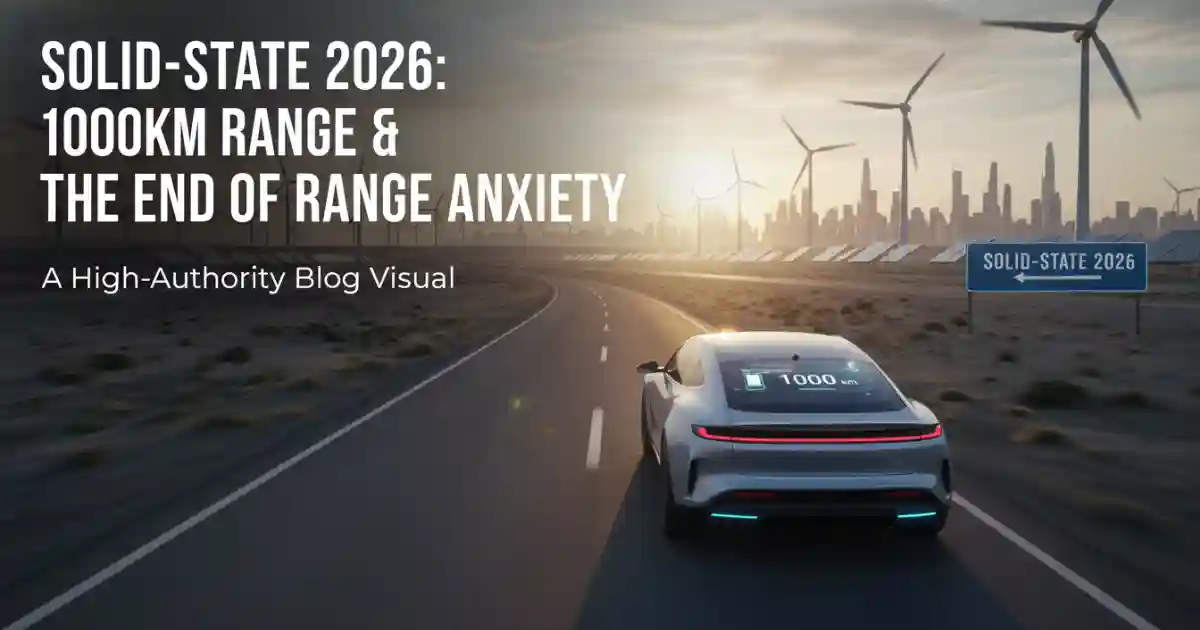
The 2026 Inflection Point: Beyond the Lithium Limit
For over a decade, the ‘Holy Grail‘ of electric mobility has been a moving target, perpetually five years away. In 2026, that timeline has collapsed into reality. The automotive landscape is currently witnessing the commercial deployment of the first true production-ready Solid-State Batteries (SSBs), marking the most significant propulsion shift since the internal combustion engine.
Companies like Donut Lab and Chery have moved beyond lab-scale prototypes, delivering cells that shatter the theoretical limits of traditional Lithium-Ion (Li-ion) chemistry. The metrics defining this new era are not incremental; they are exponential. We are no longer discussing a 10% range increase.
We are analyzing a fundamental architectural change that delivers energy densities exceeding 400 Wh/kg, charging times under five minutes, and a safety profile that effectively eliminates the risk of thermal runaway. This deep dive explores the technical anatomy of 2026’s solid-state revolution, the chemistry solving the ‘dendrite dilemma,’ and the manufacturing realities of this sovereign circularity.

Anatomy of a Breakthrough: Solid vs. Liquid Electrolytes
To understand the magnitude of the 2026 shift, one must first dissect the limitations of the incumbent technology. Traditional Li-ion batteries rely on a liquid organic electrolyte to transport lithium ions between the cathode and anode. While effective, this liquid is flammable, volatile, and requires heavy separators to prevent short circuits. Furthermore, it imposes a hard ceiling on voltage and energy density.
Solid-state technology replaces this volatile liquid with a solid material—typically a ceramic, glass, or sulfide-based electrolyte. This substitution is not merely a component swap; it is a structural revolution. The solid electrolyte acts as both the ion conductor and the separator, allowing for the use of a Lithium-Metal anode instead of the traditional graphite/silicon mix. This switch to Lithium-Metal is the key unlock for the massive energy density gains seen in 2026 models (.
Solving the Dendrite Dilemma
The primary barrier to SSB commercialization has historically been ‘dendrites‘—needle-like lithium structures that grow from the anode during charging. In liquid cells, these dendrites can pierce the separator, causing catastrophic short circuits and fires. For years, solid electrolytes struggled to physically block these formations without cracking.
The breakthroughs we see in 2026, particularly from innovators utilizing sulfide-based electrolytes, involve a multi-layered interface design. By engineering a ‘semi-solid’ buffer layer or utilizing advanced ceramic weaves, the new generation of cells suppresses dendrite growth mechanically and chemically.
The solid electrolyte is now robust enough to force lithium to deposit smoothly (planar deposition) rather than in spikes, enabling the safe use of pure lithium metal anodes.

Performance Benchmarks: The 400 Wh/kg Standard
The definitive metric for 2026 is specific energy density. For context, the best commercial Li-ion cells in 2025 (such as the 4680 format) peaked around 270–296 Wh/kg. The new wave of solid-state cells entering the market boasts densities of 400 Wh/kg to 500 Wh/kg. This leap allows for two distinct design philosophies for OEMs: maintaining current range with a battery pack that is 40% lighter, or maintaining current weight to achieve ranges exceeding 1,000 kilometers (620 miles).
The 5-Minute Charge and Cycle Life
Beyond range, the user experience is transformed by charging speed. Solid electrolytes have higher ionic conductivity at high voltages and are thermally stable. This allows for aggressive charging protocols that would boil a liquid electrolyte. The 2026 standard for premium SSBs is a 0–80% charge in under 5 minutes. This effectively mirrors the refueling time of gasoline vehicles, neutralizing the final consumer objection to EV adoption.
Furthermore, the degradation curve has flattened. Liquid electrolytes degrade over time due to parasitic side reactions with the electrodes (forming the SEI layer). Solid interfaces are far more stable. Data from early 2026 deployments suggests a cycle life exceeding 100,000 cycles for certain chemistries. This longevity implies the battery will outlast the vehicle chassis itself, potentially creating a secondary market for ‘million-mile’ battery packs that can be repurposed for grid storage.

Manufacturing: The ‘Dry Room’ Challenge and Circularity
While the chemistry is proven, the manufacturing ramp-up remains the industry’s critical bottleneck. Producing solid-state batteries requires a fundamental retooling of the Gigafactory. The primary challenge is the moisture sensitivity of sulfide electrolytes. Even trace amounts of humidity can degrade the electrolyte into toxic hydrogen sulfide gas. Consequently, SSB production lines must operate in ‘Dry Rooms’ with dew points lower than -40°C, significantly increasing capital expenditure.
However, this cost is offset by the simplification of the cell architecture. SSBs utilize a ‘Bipolar’ stacking method (Figure 3), where cells are stacked directly in series without the need for individual casings and complex cooling channels required for liquid cells. This reduces the passive weight and volume of the pack, improving the ‘Pack-to-Chassis’ efficiency.

Sovereign Circularity
A defining trend of 2026 is ‘Sovereign Circularity.’ As geopolitical tensions affect raw material supply chains, the industry is pivoting toward materials that can be locally sourced and recycled. SSBs support this by reducing reliance on cobalt and nickel (often used in liquid cathodes) in favor of sulfur or abundant iron-phosphate derivatives in next-gen iterations. The rigid, solid structure also simplifies the recycling process, as the materials are easier to separate mechanically than the slurry mess found in crushed Li-ion cells.
The End of the ICE Age
The arrival of solid-state batteries in 2026 is not just an upgrade; it is a replacement technology. It resolves the ‘trilemma’ of energy density, safety, and charging speed that has plagued electric vehicles since their inception. With 1,000km ranges becoming the premium standard and safety risks virtually eliminated, the internal combustion engine loses its last remaining functional advantages—range and refueling speed. As manufacturing scales and costs achieve parity with Li-ion (projected for late 2027), the automobile is being redefined not by the sound of its engine, but by the silence of its unlimited potential.




Составляя план поездку в Таиланд, многие путешественники озадачены вопросом, сколько стоит турпутёвка в Тайланд и сколько брать денег на отдых. Скажем, путёвка в Тайланд ценник зависит от сезона — желательно ехать в Тайланд, Пхукет в сезон с ноября по февраль, когда климатические условия крайне благоприятная. На Пхукете рекомендую познакомиться с рынком Патонг и ТЦ на Патонге, где можно не только подобрать сувениры, но и вкусить редкие фрукты Таиланда. Развёрнуто про расценки, туры и переезды, в том числе паром Пхукет Самуи, можно почитать здесь [url=https://bangkokescape.ru]обменники на пхукете[/url] .
Относительно ориентирования, в аэропорту Пхукета навигация довольно легко: главная важных проблем — решить самый приемлемый обменник на Пхукете или надёжное такси до отеля. За 10 дней на Пхукете часто подсказывают брать с собой количество денег, примерно приблизительно 30-40 тысяч бат, чтобы уверенно погасить прокат байка, массажи и пропитание. Если любопытно, что удобнее — Самуи или Пхукет, то тот и другой пункт чудесен по-своему, и немало обусловлено ваших требований, так, настроение пляжей или обзорные маршруты.
В случае если планируете поездку в Таиланд, стоит предварительно ознакомиться с базовыми островами, такими как Пхукет и Самуи. Пляжи Самуи на карте удобны для выбора безупречного места отдыха, а для движения между островами пхукет самуи как добраться — ключевой вопрос. Кстати, стоит принимать во внимание разницу во времени с Таиландом и правила въезда в Таиланд 2025, чтобы поездка получилась максимально комфортно.
Для тех, кто любопытствует ценами, целесообразно знать, сколько денег брать в Таиланд на 10 дней и размер оплаты аренды байка на Пхукете. Также советую почитать отзывы об андаманда Пхукет и познакомиться с океанариум Пхукет, это отличный способ разнообразить отдых. Обстоятельнее по планированию путешествия и обмен валюты Пхукет можно отыскать здесь [url=https://thaiescape.ru]дайвинг на пхукете[/url] .