
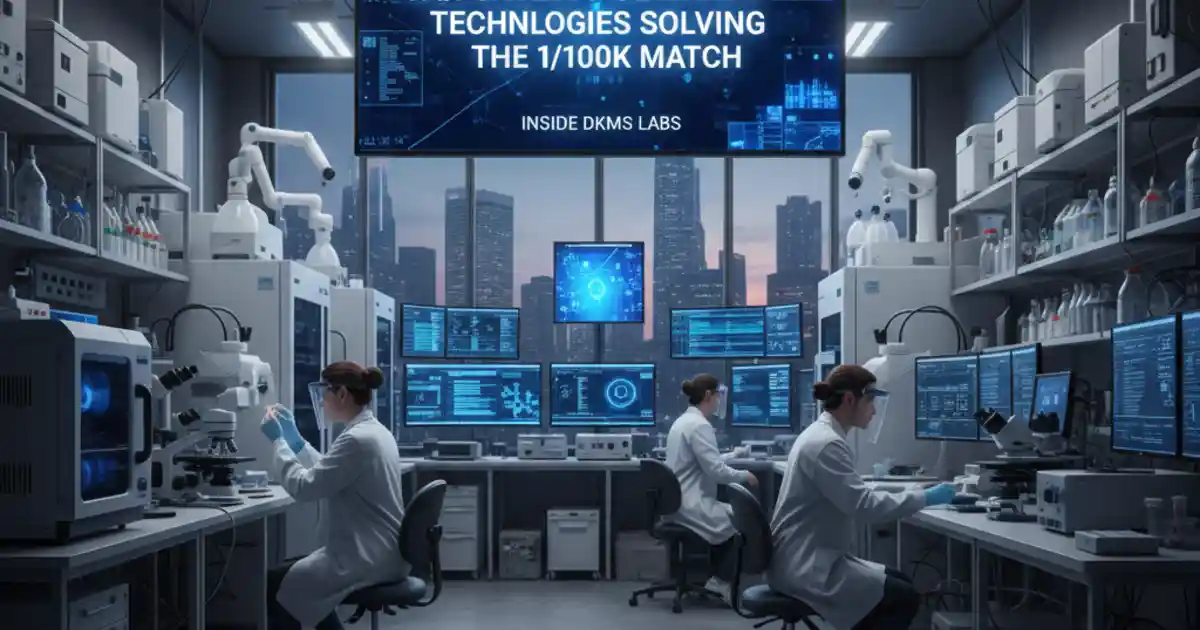
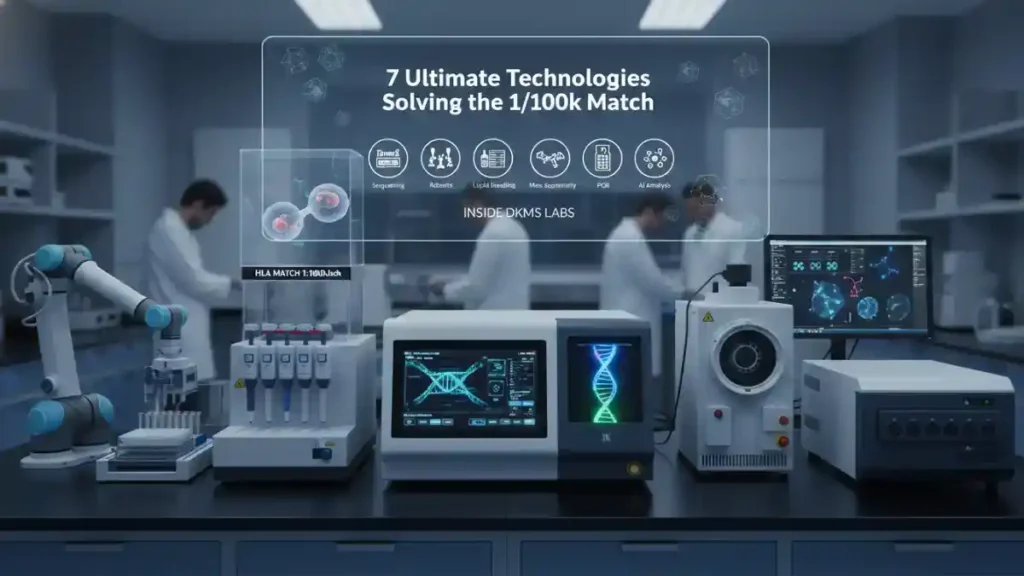
Millions of Lives Can Saved: 7 Ultimate Technologies Solving the 1/100k Match: Inside DKMS Labs
Millions of Lives Can Saved: 7 Ultimate Technologies
The Engineering Challenge of Saving a Life
In the sanitized corridors of modern medicine, we often fixate on the final miracle: the patient cured, the family reunited, the cancer in remission. But underlying these emotional triumphs is a cold, hard engineering problem. It is a problem of probability, logistics, and data throughput.
Specifically, for a patient with blood cancer needing a stem cell transplant, the probability of finding a match is roughly *1 in 100,000*. This is not merely a medical procedure; it is a search query run against a biological dataset of billions of variables.
To solve this, organizations like DKMS have had to transcend traditional laboratory methods. They have built what is effectively a high-performance computing facility for biology. The DKMS Life Science Lab in Dresden, Germany, is the world’s largest HLA typing laboratory, processing over 1.2 million samples annually.
This facility does not just ‘test blood’; it digitizes the human genome at an industrial scale. Today, we dissect the technical infrastructure of this lab—from magnetic bead physics to water-bath PCR—to understand how technology beats the odds.
1. The Combinatorial Nightmare: Understanding HLA
To appreciate the hardware, one must first understand the software problem: the human genome. Unlike blood transfusions, where we deal with a manageable set of types (A, B, AB, O, and the Rh factor), stem cell transplantation depends on **Human Leukocyte Antigens (HLA)**.
These proteins are the immune system’s identification cards, encoded by the Major Histocompatibility Complex (MHC) on chromosome 6. The complexity arises from the sheer variance. There are over **35,000 known HLA alleles** as of recent counts. The immune system uses these markers to distinguish ‘self’ from ‘non-self’.
If a donor’s HLA markers do not align almost perfectly with the patient’s, the recipient’s body will reject the graft, or worse, the graft will attack the host (GvHD). From a data perspective, this is a high-dimensional matching problem.
The 1 in 100,000 statistic is an average; for ethnic minorities with underrepresented genetic data, the odds can be far worse. Solving this requires a database of massive magnitude and a throughput engine capable of populating it rapidly.

2. The Input Layer: From Analog Swab to Digital Twin
The process begins with a buccal (cheek) swab. This simple analog input—a cotton tip laden with epithelial cells—must be converted into a digital sequence. Upon arrival at the lab, the logistical challenge is immediate: traceability. In a facility processing up to 7,000 samples a day, a single labeling error could be fatal.
The lab utilizes optical character recognition (OCR) and 2D barcode scanning to log every sample into the Laboratory Information Management System (LIMS) the moment it enters the airlock. This creates a ‘digital twin’ for the sample, ensuring that every subsequent step is tracked against a unique donor ID.
3. Automated Ingestion: The Rise of the Robots
Manual pipetting is the enemy of scale. It is slow, prone to Repetitive Strain Injury (RSI), and introduces human error. The DKMS lab relies on advanced liquid handling robots, primarily the **Hamilton Microlab STAR** and **NIMBUS** series. These machines are marvels of mechatronics. Equipped with multiple pipetting channels, they can process 96 or 384 samples simultaneously.
These robots utilize air-displacement technology to measure liquid volumes with sub-microliter precision. They feature ‘Monitored Air Displacement’ (MAD), which detects clots or empty wells in real-time, alerting technicians before a batch is ruined. The transition to this level of automation allows the lab to run 24/7, turning biology into a continuous production line.

4. DNA Isolation: The Physics of Magnetic Beads
Once the cells are lysed (broken open), the DNA must be separated from proteins, lipids, and other cellular debris. The old method involved centrifuges and hazardous chemicals like phenol-chloroform. The modern solution is elegant physics: **Magnetic Bead Technology**.
The lab uses silica-coated superparamagnetic beads. These microscopic beads are introduced into the lysed solution. Under specific salt conditions, DNA molecules bind tightly to the silica surface of the beads. The robot then lowers a set of magnetic rods into the plate. The beads—now carrying the DNA payload—snap onto the rods.
The robot lifts the rods, effectively pulling the DNA out of the dirty soup, and dips them into a wash buffer. The magnetic field is released, the beads disperse, and the DNA is washed. This process is repeated until the DNA is pure. It is faster, cleaner, and completely automatable compared to centrifugation.

5. Quality Assurance: Optical Density Checks
Garbage in, garbage out. Before sequencing, the concentration of the extracted DNA must be verified. If the DNA is too weak, the sequencing will fail; too strong, and it might produce noisy data. Automated spectrophotometers measure the **Optical Density (OD)** of the samples.
By analyzing the absorption of light at 260nm and 280nm, the system calculates the purity and concentration. Only samples that pass this automated gate move forward to the amplification stage.
6. The Hydrocycler: Amplification at Speed
This is one of the most distinct technologies in high-throughput labs. Polymerase Chain Reaction (PCR) is the process of copying specific DNA segments (the HLA genes) millions of times so they can be read. Traditional thermal cyclers use Peltier elements (electric heating/cooling plates) to change temperature. This involves ‘ramping’—waiting for the block to heat up or cool down.
Enter the **LGC Hydrocycler**. Instead of a single changing block, the Hydrocycler uses multiple water baths kept at constant, precise temperatures (e.g., 95°C for denaturation, 60°C for annealing, 72°C for extension). A robotic arm physically moves the baskets of PCR plates between these water baths.
Because water has high thermal conductivity and the baths are already at target temperature, the heat transfer is almost instantaneous. This eliminates ramp time, reducing the total PCR cycle time by up to 40%. In a lab processing millions of samples, this efficiency gain is monumental.

7. Library Prep: Serialization and Barcoding
How do you sequence 5,000 people in one machine run without mixing up their data? The answer is **Molecular Barcoding**. During the library preparation phase, short synthetic DNA sequences (indexes) are attached to the ends of the donor’s DNA fragments. Each donor gets a unique combination of indexes.
This process, known as multiplexing, allows the lab to pool thousands of samples into a single tube. The sequencer reads everything at once, and the bioinformatics software later sorts (demultiplexes) the reads based on these barcodes. It is the biological equivalent of assigning a primary key to a database entry.
The precision of liquid handling robots is critical here; a splash of one barcode into a neighboring well would corrupt the data integrity of the registry.
8. Next-Generation Sequencing (NGS)
The core of the operation is **Next-Generation Sequencing**. The DKMS lab was an early adopter of this technology for HLA typing. Platforms like the **Illumina NovaSeq** or **MiSeq** use a method called Sequencing by Synthesis (SBS).
The pooled DNA libraries are loaded onto a flow cell—a glass slide with nanoscopic lanes. Inside, the DNA fragments adhere to the surface and are amplified into clusters. As the machine floods the cell with fluorescently labeled nucleotides (A, C, T, G), a high-resolution camera captures the light emitted as each base is added.
This happens in parallel for millions of clusters. The result is terabytes of raw text data representing the genetic code of thousands of donors. This moves the bottleneck from biology to computation.

9. Long-Read Sequencing: The Phasing Problem
While short-read sequencing (Illumina) is efficient, HLA genes are highly repetitive and complex. Sometimes, it is difficult to tell which mutations belong to the maternal chromosome and which to the paternal one—a problem known as ‘phasing’. To solve this, labs are increasingly integrating **Long-Read Sequencing** (like PacBio SMRT or Oxford Nanopore).
These technologies read much longer stretches of DNA without breaking them, providing a continuous view of the gene. This ensures that the HLA type recorded in the database is ‘phase-resolved’, virtually eliminating ambiguity in the matching process.
10. The Bioinformatics Pipeline
Once the sequencer finishes, the ‘wet lab’ work is done, and the ‘dry lab’ begins. The raw data (FASTQ files) enters a high-performance computing cluster. Custom algorithms align these millions of short reads against a reference database of known HLA alleles (the IPD-IMGT/HLA Database).
The software must handle noise, PCR errors, and novel alleles that have never been seen before. When a new allele is discovered, it is submitted to the global scientific community. This computational pipeline is the filter that turns raw light signals into a life-saving medical report. The system assigns the donor a specific HLA type (e.g., HLA-A*02:01, HLA-B*44:02) which is then uploaded to the registry.
11. The Global Registry: Reducing Latency
The final piece of the puzzle is the network. DKMS operates essentially as a distributed cloud database. A patient in Mumbai might have a genetic twin in Berlin, London, or Santiago. The data generated in the Dresden lab flows into the **Bone Marrow Donors Worldwide (BMDW)** network. This interconnectivity is vital. In the past, searching for a donor involved faxing requests between national registries.
Today, the search is algorithmic and near-instantaneous. The ‘latency’ of the system—the time from a patient’s diagnosis to finding a potential match—has been drastically reduced by this global data integration. The larger the network of nodes (donors), the more robust the system becomes against the high variability of human genetics.

12. Cold Chain and Logistics
When a match is found, the physical world re-enters the equation. The stem cells must be harvested and transported. This requires a military-grade logistics operation involving cryopreservation and strict cold-chain custody. Liquid nitrogen dry shippers keep the cells at -196°C during transcontinental flights. While not part of the genotyping lab, this logistical capability is the necessary endpoint of the data science victory.
13. Future Technologies: AI and Third-Gen Sequencing
The lab continues to evolve. Artificial Intelligence is beginning to play a role in predicting the likelihood of a successful transplant beyond just HLA matching, looking at ‘permissive mismatches’ and other genetic factors. Furthermore, Third-Generation Sequencing (nanopore technology) promises to make the machines smaller and faster, potentially allowing for ‘bedside typing’ in the future.
14. The Human Element: Registering the World
Despite the automation, the limiting factor remains the number of registered donors. The 1 in 100,000 probability can only be beaten by volume. Every new registrant adds a new data point, a new possibility for a match. The technology is scalable; it can handle millions more. The challenge now is societal—convincing enough people to provide that initial buccal swab.
A Triumph of Engineering
The DKMS Life Science Lab is a testament to what happens when engineering principles are applied to biological problems. It is a facility where magnetic fields, lasers, water baths, and supercomputers converge to solve a single, devastating equation of probability. It turns the ‘needle in a haystack’ problem into a sortable database query.
While the biology is complex, the outcome is simple: a second chance at life. The swab takes minutes, but the infrastructure behind it is a monument to human ingenuity.


Alright, 8okwin, show me what you got! Giving it a shot tonight. Wish me luck, folks! 8okwin
Hi Friends,
Thank you for sharing your own experience with dishamunch.com ! I love hearing how different readers adapt recipes and ideas to their own kitchens. Your tip about response is fantastic.
Thanks for contributing your perspective – it adds so much to our community!
– Dr. Pavitra Singh at DISHA (Divyang/disabled Identity Safety Help Association) Munch”
Hi Friends,
Thank you for sharing your own experience with dishamunch.com ! I love hearing how different readers adapt recipes and ideas to their own kitchens. Your tip about response is fantastic.
Thanks for contributing your perspective – it adds so much to our community!
– Dr. Pavitra Singh at DISHA (Divyang/disabled Identity Safety Help Association) Munch”
Thanks
Hi Friends,
Thank you for sharing your own experience with dishamunch.com ! I love hearing how different readers adapt recipes and ideas to their own kitchens. Your tip about response is fantastic.
Thanks for contributing your perspective – it adds so much to our community!
– Dr. Pavitra Singh at DISHA (Divyang/disabled Identity Safety Help Association) Munch”
Hi Friends,
Thank you for sharing your own experience with dishamunch.com ! I love hearing how different readers adapt recipes and ideas to their own kitchens. Your tip about response is fantastic.
Thanks for contributing your perspective – it adds so much to our community!
– Dr. Pavitra Singh at DISHA (Divyang/disabled Identity Safety Help Association) Munch”