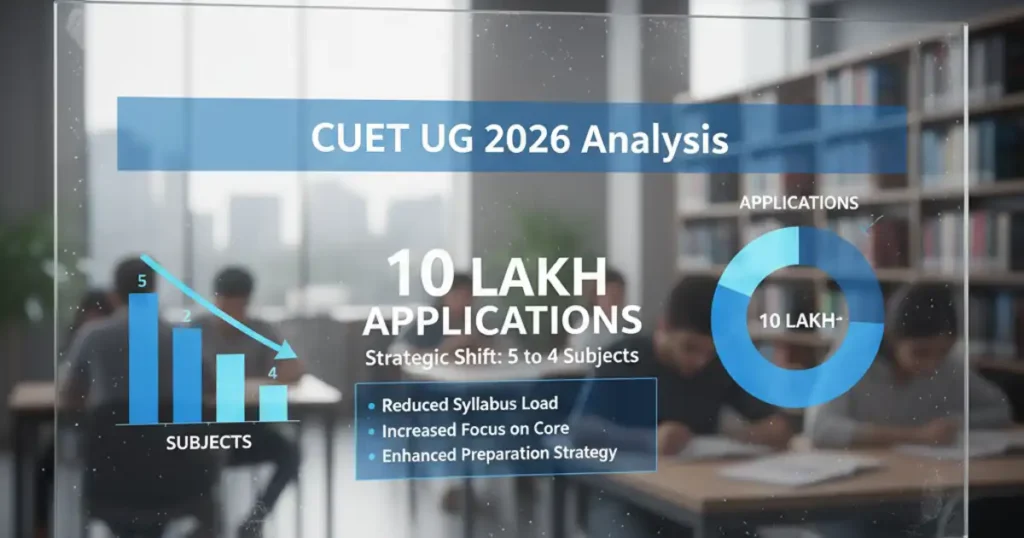
CUET UG 2026 Analysis: 10 Lakh Applications & The Strategic Shift from 5 to 4 Subjects
The New Era of CUET UG 2026: Quality Over Quantity
The landscape of Indian higher education is witnessing a significant evolution with the Common University Entrance Test (CUET) UG 2026. As the National Testing Agency (NTA) processes an overwhelming volume of registrations, a distinct narrative is emerging from the data. We have officially crossed the monumental milestone of 10 lakh (1 million) applications yet again, cementing CUET’s position as the second-largest competitive exam in the country.
However, the headline this year isn’t just the sheer volume of aspirants; it is the strategic pivot in how these aspirants are approaching the examination. In a departure from the trends observed in the nascent years of CUET, 2026 marks the year of the ‘Focused Approach.’
While the NTA provides the flexibility to choose up to five or six subjects (depending on the specific year’s brochure nuances), a granular analysis of the application forms reveals that the majority of students are opting to sit for only four subjects. This change is not accidental; it is a calculated move by students and counselors alike to maximize scoring potential and align strictly with the eligibility criteria of target universities.
Breaking Down the 10 Lakh Milestone
Reaching the 10 lakh application mark is a testament to the centralization of university admissions in India. The numbers indicate that despite the teething troubles of previous years, the student community has accepted CUET as the singular gateway to their collegiate dreams. This massive cohort includes students from various boards—CBSE, ICSE, and state boards—converging on a single platform. The consistency in high application numbers suggests that the awareness regarding the exam has penetrated tier-2 and tier-3 cities effectively.
However, high application numbers also imply intensified competition. With over a million candidates vying for limited seats in prestigious institutions like Delhi University (DU), Banaras Hindu University (BHU), and Jawaharlal Nehru University (JNU), the margin for error has shrunk. This competitive pressure is a primary driver behind the changing trends in subject selection. Students are no longer ‘spraying and praying’ by selecting maximum subjects; they are sniping for high percentiles in their strongest domains.

The Shift from 5 to 4 Subjects: A Strategic Analysis
The most compelling story of CUET UG 2026 is the statistical drop in the average number of subjects selected per candidate. In previous years, the prevailing logic was ‘more subjects equal more options.’ Students would often select a General Test, one or two languages, and three to four domain subjects, totaling 5 or 6 papers. The rationale was to keep doors open for multiple streams. For instance, a Science student might take Economics to keep a Commerce door ajar.
In 2026, this trend has reversed. The data shows a heavy inclination towards choosing just four subjects. Typically, this combination includes one Language (mandatory for almost all universities), and three Domain Subjects (specifically the ones studied in Class 12). Why is this happening? The answer lies in the ‘Best of’ calculation. Most top-tier universities, including Delhi University, calculate the merit score based on the ‘Best 3 Domains + 1 Language.’ Students have realized that taking a 5th or 6th subject often dilutes their preparation time without adding value to their final merit score if it isn’t their strongest suit.
The ‘Focused Approach’: Why Less is More
The shift to four subjects signifies a maturation of the aspirant pool. Students are now displaying a ‘Focused Approach.’ Instead of spreading their study hours across five or six subjects, they are concentrating all their energy on the four subjects that matter most for their desired course. This depth-over-breadth strategy is likely to result in higher cut-offs this year, as students will be better prepared for the fewer subjects they have chosen.
For example, a student aiming for B.Sc. Physics Honors knows that their merit will largely depend on Physics, Chemistry, and Mathematics (PCM) scores plus a language. Adding a subject like ‘General Test’ or ‘Physical Education’ might be unnecessary if their target university doesn’t require it for that specific course. By dropping the extra baggage, they can dedicate 25% more revision time to their core PCM subjects, potentially boosting their normalized score.

University Eligibility Criteria Driving the Change
The root cause of this behavioral shift lies in the eligibility criteria defined by participating universities. Over the last few cycles, universities have clarified their mapping. For the vast majority of ‘Honors’ courses in Humanities, Science, and Commerce, the requirement is strictly based on Class 12 domain subjects. The ambiguity that existed in 2022 and 2023 has dissipated. Students now understand that taking a subject in CUET that they did not study in Class 12 is often futile for admission into traditional courses.
Furthermore, the realization that the ‘General Test’ is not mandatory for all courses has led to a decline in its selection among pure Science and Humanities aspirants. While the General Test remains crucial for courses like BBA or BMS, those targeting B.A. History or B.Sc. Zoology are opting out of it to focus solely on their domain expertise.
Impact on CUET 2026 Cut-offs
What does this mean for the cut-offs? Paradoxically, taking fewer subjects might lead to higher cut-offs. With students focusing their preparation on a narrower set of subjects, the average proficiency in those subjects is expected to rise. We can anticipate a higher density of students scoring in the 95th to 99th percentile range in popular domains like Political Science, Commerce, and Physics. The competition is no longer about who knows a little about everything, but who has mastered their core four.
NTA’s Role and Examination Logistics
The National Testing Agency (NTA) has also streamlined the process for 2026. Managing a logistical behemoth like CUET is easier when the number of tests per student decreases. A reduction from an average of 5 tests to 4 tests per candidate significantly reduces the number of shifts required, the burden on exam centers, and the complexity of the normalization process. This might result in a smoother conduct of the exam and faster declaration of results, addressing a major pain point from previous years.

Expert Opinions: Educators Weigh In
Leading career counselors and educators have welcomed this trend. Dr. Sharma, a senior education analyst, notes, ‘The 4-subject trend is a sign of a smarter candidate. In 2024 and 2025, we saw students burning out by preparing for 6 subjects and performing average in all. The 2026 cohort is prioritizing quality. They realize that a 100 percentile in 3 domains is better than an 80 percentile in 5.’
However, experts also warn against over-optimization. There is a risk that if a student performs poorly in one of the only four subjects chosen, they have no backup score to fall back on. The ‘Best of’ calculation requires a safety net, which the 5th subject previously provided. Students choosing only 4 are effectively playing a high-stakes game where every exam session counts.
Preparation Strategy for the ‘Focused’ Candidate
For those adhering to the 4-subject trend, the preparation strategy must be intense. The syllabus for domain subjects must be covered cover-to-cover from the NCERT textbooks. Since there is no backup subject, candidates cannot afford to skip chapters. Mock tests should be specific to these four subjects, and time management strategies should be honed to perfection. The focus should be on accuracy; with fewer subjects, the normalized score volatility can be higher if raw scores drop.
Application Data: A Regional Perspective
Geographically, the application surge is not limited to the metros. Data indicates a massive uptick in applications from states like Uttar Pradesh, Bihar, and Rajasthan. This demographic is largely favoring the 4-subject combination involving Hindi/English and three core arts or science subjects. This indicates that the messaging regarding the ‘Focused Approach’ has been disseminated effectively through regional coaching centers and online educational platforms.
The Hybrid Mode Factor
Another factor influencing subject choice is the potential for Hybrid Mode exams (Pen-Paper + CBT). If NTA conducts high-volume subjects (like English or General Test) in Pen-Paper mode to reduce shifts, students might be selecting subjects based on their comfort with the testing medium. However, the primary driver remains the subject mapping for university admission.

What to Do If You Haven’t Applied Yet?
For students who are yet to apply or are in the correction window phase, the advice is to critically evaluate your target courses. If you are aiming for a specialized course that requires a General Test (like BBA), do not skip it just to follow the trend. However, if your goal is a standard B.A., B.Sc., or B.Com Honors, verify the requirements of your top 5 target universities. If they only demand 3 Domains + 1 Language, sticking to 4 subjects is a statistically sound strategy.
CUET UG 2026 Application Statistics: Crossing the 10 Lakh Mark
The enthusiasm for CUET UG 2026 is palpable. As of late January, official sources confirm that the registration count has surged past 10 lakh unique candidates. This number is expected to rise further as the last-date rush kicks in. The high number of applicants ensures that competition will remain fierce, necessitating high normalized scores for admission into top-tier colleges like Hindu College, Miranda House, or SRCC.
The 10 lakh+ figure also validates the acceptance of CUET as the standard for undergraduate admissions. It is no longer an experiment but the definitive path for Class 12 students. The NTA’s infrastructure will be tested again, with the exam scheduled to be held in Hybrid mode (CBT + Pen & Paper for high-volume subjects) to accommodate this massive cohort across thousands of centers in India and abroad.

Critical Dates for CUET UG 2026
Missing a deadline can be fatal for your academic year. The NTA has released a strict schedule for the 2026 cycle. Ensure you mark these dates on your calendar.
Registration Window: Start Date: January 03, 2026
End Date January 30, 2026 (Up to 11:50 PM)
Last Date for Fee Payment: January 31, 2026
Correction & Exam Schedule: Correction Window: February 02 – February 04, 2026
Exam City Announcement: To be announced (Likely April 2026)
Admit Card Release: 3-4 days before the exam
Exam Dates: May 11 – May 31, 2026
Eligibility Criteria: Who Can Apply?
Before you rush to the portal, verify your eligibility. The basic criteria set by NTA are broad, but individual universities have specific requirements.
1. Age Limit: For appearing in the CUET (UG) – 2026, there is **no age limit** for the candidates. The candidates who have passed the class 12 /equivalent examination or are appearing in 2026 irrespective of their age can appear in the CUET (UG) – 2026 examination. However, candidates will be required to fulfill the age criteria (if any) of the University regarding which they are desirous of taking admission.
2. Educational Qualification: Passed Class 12th or equivalent examination from a recognized board.
Candidates appearing in Class 12th in 2026 are also eligible.
Note: You must check the specific subject requirements for your desired course (e.g., Physics + Chemistry + Math for B.Sc. Physics) on the website of the respective university.
Fee Structure for CUET UG 2026
The fee structure is tiered based on the number of subjects chosen and the candidate’s category. Since most students are opting for 4 subjects, they will likely fall into the ‘Up to 3 Subjects’ base tier plus the cost for one additional subject.
Base Fee (For up to 3 Subjects):
General (UR): ₹1000
OBC-NCL / EWS:* ₹900
SC / ST / PwBD / Third Gender: ₹800
Centres Outside India: ₹4500
**Fee for Additional Subjects (Per Subject):** * **General (UR):** ₹400 * **OBC-NCL / EWS:** ₹375 * **SC / ST / PwBD / Third Gender:** ₹350 * **Centres Outside India:** ₹1800

Step-by-Step Guide: How to Apply Online
The application process is entirely online. Follow these steps carefully to avoid rejection.
**Step 1: Registration** Visit the official website **cuet.nta.nic.in**. Click on ‘New Registration’. Download the Information Bulletin and read it. Register using your Email ID and Mobile Number. You will generate an Application Number and Password.
**Step 2: Application Form Filling** Login using the Application Number. Fill in your personal details, educational qualifications, and address. * **University Selection:** Select the Universities and Programs you intend to apply for. (Tip: Select as many as relevant to maximize options). * **Test Paper Selection:** This is crucial. Choose your 4 (or up to 5) subjects. Ensure they map to the eligibility of your selected courses.
**Step 3: Upload Documents** Upload scanned images of: * Recent Photograph (Color or B/W, with 80% face visible). * Signature. * Category Certificate (if applicable). * PwBD Certificate (if applicable).
**Step 4: Fee Payment** Pay the requisite examination fee through Net Banking/Credit Card/Debit Card/UPI. Keep the proof of transaction.
**Step 5: Confirmation Page** Once payment is successful, the Confirmation Page will be generated. **Download and print** this page. It is the only proof of your successful application.
Exam Pattern 2026: What to Expect
The CUET UG 2026 will continue with the objective-type Multiple Choice Question (MCQ) format. However, the mode of examination is Hybrid.
Mode:Hybrid (Pen & Paper for subjects with very high registration; CBT for others). This ensures logistical efficiency. * **Medium:** 13 Languages (English, Hindi, Assamese, Bengali, Gujarati, Kannada, Malayalam, Marathi, Odia, Punjabi, Tamil, Telugu, and Urdu). * Marking Scheme: +5 for a correct answer, -1 for an incorrect answer, 0 for unattempted.
Sections:Section IA & IB: Languages.
Section II: Domain Subjects (27 options).
Section III: General Test.

Future Outlook: Beyond 2026
The trends of 2026 will likely shape the future policy of NTA. If the 4-subject model proves successful in streamlining admissions without compromising student opportunities, we might see a formalization of this structure in future editions. It challenges the ‘One Nation, One Exam’ concept to evolve from a ‘comprehensive test’ to a ‘specialized aptitude test.’ The data gathered from this year’s 10 lakh applicants will be crucial in modeling the 2027 examination framework.
CUET UG 2026 is turning out to be a landmark year, characterized by high volume but even higher strategic clarity. The shift from selecting 5 subjects to 4 is not merely a reduction in workload; it is an evolution in how Indian students approach competitive standardization. With over 10 lakh candidates throwing their hats in the ring, the battle for the top central universities will be fought on the grounds of precision and depth. As we move closer to the exam dates, the students who have aligned their subject choices with their true strengths and university requirements are the ones most likely to succeed in this new, focused era of admissions.