
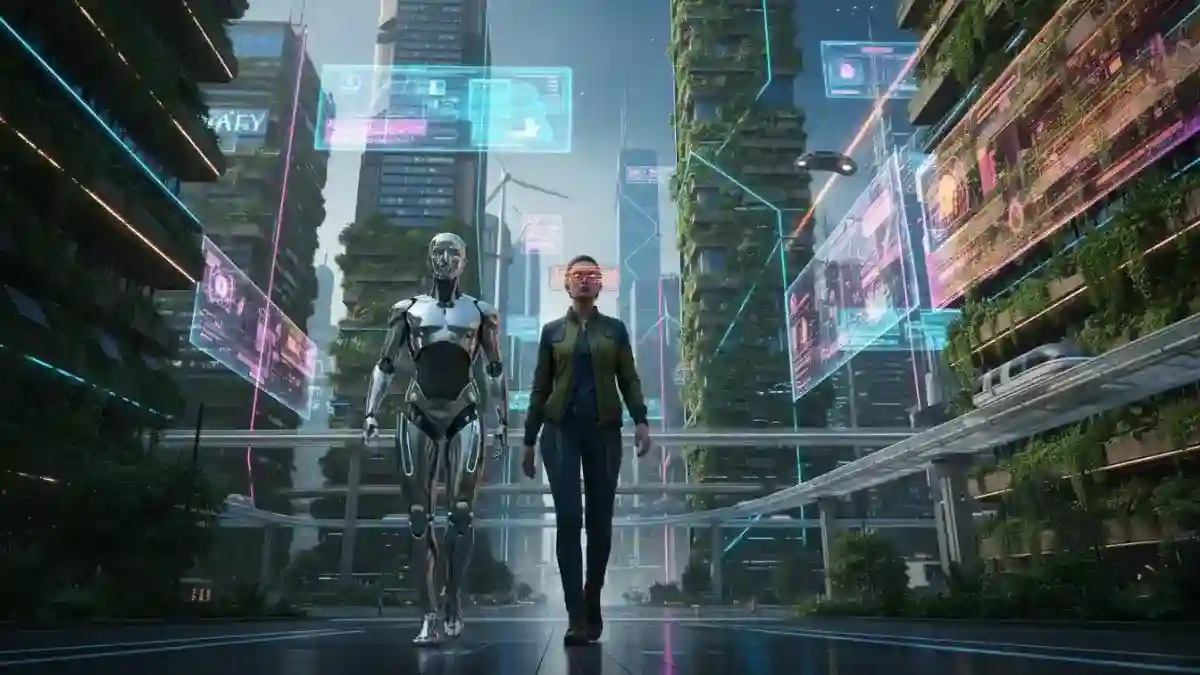
12 Shocking Tech Trends of 2026: The Ultimate Future Guide
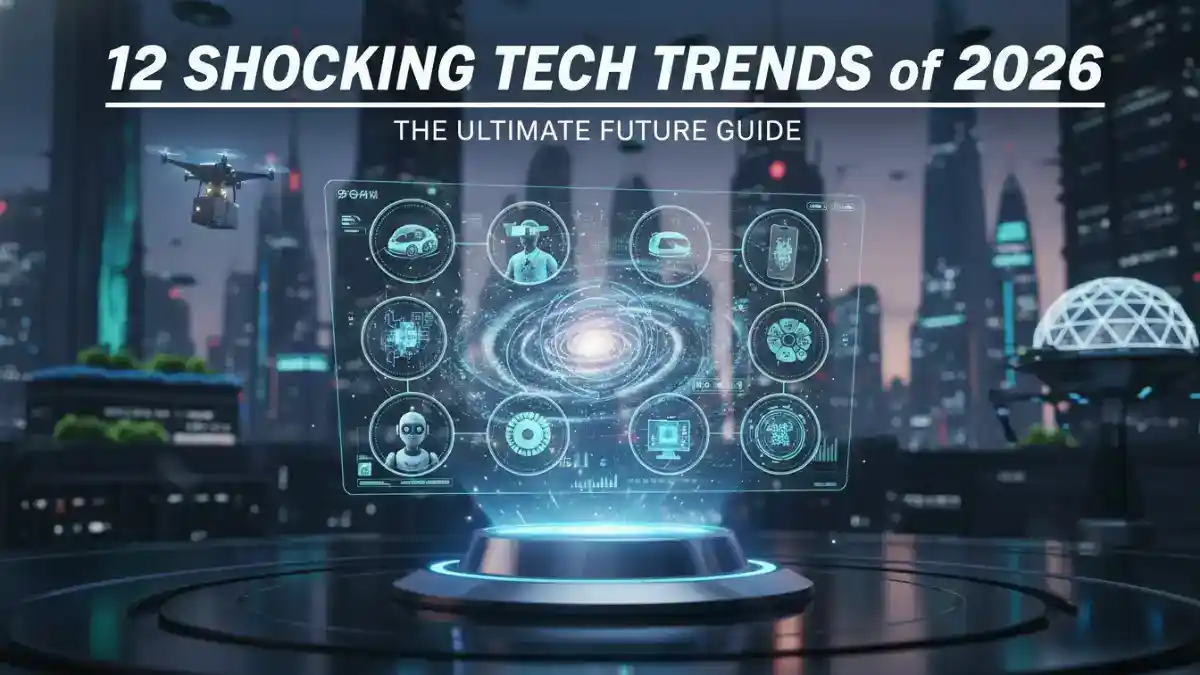
We are standing on the precipice of a technological singularity. The year 2026 marks a definitive shift in the global tech landscape, moving from an era of experimental ‘Innovation‘ to a phase of aggressive ‘Acceleration.’ The technologies that were theoretical buzzwords just five years ago—Generative AI, Quantum Computing, and Bio-hacking—are now industrial realities defining the economic and geopolitical battlefield.
For CIOs, investors, and tech enthusiasts, 2026 is not just another year; it is the checkpoint where digital sovereignty, physical AI, and autonomous agents begin to reshape human existence. This isn’t just about faster phones or sharper screens. The trends of 2026 are ‘shocking’ because they represent a fundamental decoupling of productivity from human labor and a re-architecting of trust itself.
As Gartner and MIT Technology Review have highlighted, we are entering a period where ‘Physical AI‘ brings intelligence to machinery, and ‘Agentic AI’ begins to make decisions without human oversight. This guide serves as your exhaustive, encyclopedic roadmap to the 12 most dangerous, powerful, and transformative technology trends defining 2026.
Agentic AI: The Death of Passive Chatbots
The era of the passive chatbot is over. In 2026, we witness the rise of *Agentic AI*—autonomous systems capable of pursuing complex goals with minimal human intervention. Unlike the Large Language Models (LLMs) of 2024 that required constant prompting, Agentic AI possesses ‘agency.’
It can plan, reason, execute multi-step workflows, and even recruit other AI agents to complete tasks. This shift is monumental. We are moving from ‘Chat with Data’ to ‘Act on Data.’

Enterprises are deploying these agents to automate entire departments. Imagine a marketing AI that doesn’t just write copy but analyzes market trends, generates the imagery, purchases the ad space, and optimizes the budget in real-time. The implications for the workforce are profound.
As we discuss in our deep dive on, the ability of these agents to self-correct and learn creates a compounding loop of efficiency that human employees cannot match. This is the year software starts writing software at an industrial scale.
Quantum Advantage & The ‘Harvest Now, Decrypt Later’ Crisis
Quantum computing has long been the ‘future’ technology that never quite arrives. In 2026, however, the narrative shifts from ‘Quantum Supremacy’ to *Quantum Commercialization*.
While a fully fault-tolerant universal quantum computer may still be on the horizon, the ‘NISQ’ (Noisy Intermediate-Scale Quantum) era is delivering tangible value in material science and logistics. Companies are using quantum annealers to solve optimization problems that classical supercomputers would take centuries to crack.

However, this power comes with a dark side. The threat of ‘Harvest Now, Decrypt Later’ (HNDL) attacks has reached a fever pitch. Adversarial nations are hoarding encrypted global data today, waiting for the quantum keys of tomorrow to unlock it.
As noted in the market for quantum technologies is projected to exceed $100 billion, but the cost of not preparing for Post-Quantum Cryptography (PQC) could be existential for the banking and defense sectors. Read more about these developments in our section.section.
Physical AI: When Robots Get ‘Brains’
Gartner identifies *Physical AI* as a top strategic trend for 2026. This is the convergence of advanced generative AI models with robotics. Until now, robots were deaf, dumb, and blind machines that followed rigid code. Physical AI gives them eyes (computer vision), ears (audio processing), and a brain (LLMs for reasoning).
This allows robots to understand natural language commands like ‘Clean up that spill’ or ‘Assemble the red chassis’ without needing explicit programming for every movement.
This trend is revolutionizing manufacturing, logistics, and elder care. Humanoid robots are leaving the R&D labs and entering the workforce. The friction between human labor and robotic efficiency is set to be the defining labor dispute of the decade. We explore this further in our article on the
Preemptive Cybersecurity Mesh Architecture (CSMA)
With AI agents and quantum threats on the rise, the old ‘castle and moat’ security model is obsolete. 2026 is the year of *Cybersecurity Mesh Architecture (CSMA)*. This approach decentralizes security, enforcing identity-based controls at every access point—whether it’s a user’s laptop, an IoT sensor, or a cloud container. It is the evolution of Zero Trust into a composable, scalable fabric.
The ‘Shocking‘ aspect here is the rise of *Preemptive Cybersecurity*. Utilizing AI, security systems now predict attacks before they happen. They analyze behavioral anomalies in real-time and dynamically reconfigure the mesh to isolate threats. This is no longer about reaction; it’s about prediction. Organizations failing to adopt this mesh will find themselves defenseless against AI-driven cyber warfare. Learn how to implement this in our guide to
The Biotech Revolution: CRISPR 2.0 & AI Drugs
Biology is becoming software. In 2026, *Generative AI* is not just writing text; it is writing protein sequences. The integration of AlphaFold-style models with CRISPR gene-editing technologies is accelerating drug discovery by a factor of 100x. We are seeing the first waves of ‘Hyper-Personalized Medicine,’ where treatments are designed for a specific individual’s genetic makeup.

This leads to complex ethical questions regarding ‘Designer Biology.’ While curing genetic diseases is a noble goal, the technology to enhance human traits is rapidly becoming accessible. Regulatory bodies are struggling to keep pace with the speed of innovation in this sector.
Sustainable Supercomputing: Solving the Energy Crisis
The explosive growth of AI has a hidden cost: energy. Training a single massive model consumes gigawatt-hours of electricity. In 2026, the tech industry is forced to reckon with this via *Sustainable Supercomputing*.
We are seeing a pivot toward neuromorphic computing (chips that mimic the human brain’s efficiency) and the location of data centers in extreme environments—underwater or in the Arctic—for natural cooling.
Furthermore, nuclear energy is making a tech-driven comeback. Small Modular Reactors (SMRs) are being deployed specifically to power the hyperscale data centers required for the AI era. This intersection of nuclear physics and digital intelligence is crucial for maintaining our
Digital Sovereignty & Geopatriation
The internet is fracturing. The global ‘World Wide Web’ is being replaced by the ‘Splinternet,’ driven by **Digital Sovereignty**. Nations are demanding that data generated within their borders stays within their borders. Gartner calls this trend ‘Geopatriation.’
In 2026, multinational corporations must navigate a complex web of local data laws, requiring decentralized cloud architectures that respect local governance while maintaining global connectivity.
This trend is fueled by geopolitical tensions and the realization that data is the new oil. Controlling the data means controlling the AI, and controlling the AI means controlling the future economy.
Space 3.0: Commercial Orbit & LEO Satellites
Space is no longer the sole domain of superpowers. *Space 3.0* is defined by the commercialization of Low Earth Orbit (LEO). In 2026, we see the operational maturity of private space stations and the saturation of LEO with satellite megaconstellations providing gigabit internet to every square inch of the planet.

This connectivity is the backbone of the IoT revolution, enabling autonomous shipping and remote mining operations in areas previously disconnected from the grid. However, it also raises critical concerns about orbital debris and the militarization of space assets.
6G & The Intelligent Edge
While 5G is still rolling out globally, the research into *6G* is solidifying. Expected to launch commercially around 2030, the groundwork is being laid in 2026. 6G isn’t just faster; it’s ‘intelligent.’ It integrates AI into the network layer itself, optimizing bandwidth in real-time.
This enables the ‘Intelligent Edge,’ where processing happens on the device (the edge) rather than in the cloud, reducing latency to near-zero levels required for remote surgery and holographic communication.
Digital Provenance & The Truth Crisis
In a world flooded with AI-generated content, ‘Truth’ has become a scarce commodity. *Digital Provenance* technologies (like the C2PA standard) are becoming mandatory in 2026. These cryptographic watermarks verify the origin and history of a piece of digital content. Without this verification, images and videos will be flagged as ‘unverified’ by browsers and social platforms.
This is a direct response to the Deepfake crisis. As AI becomes indistinguishable from reality, the only way to maintain trust in media, legal evidence, and democratic processes is through an immutable chain of custody for digital assets.
Neurotechnology: The Brain-Computer Interface (BCI)
Once pure sci-fi, *BCIs* are entering the early adopter phase. Companies like Neuralink and others have paved the way for non-invasive (wearable) and invasive interfaces that allow direct communication between the human brain and computers. In 2026, the focus shifts from medical restoration (helping the paralyzed move) to human augmentation—increasing memory, focus, and reaction times for healthy individuals.
Multi-Agent Systems (MAS)
Finally, we must recognize the systemic shift to *Multi-Agent Systems*. This is the architectural trend where software is built not as a monolithic block, but as a collection of specialized AI agents that negotiate and collaborate. It makes software resilient, scalable, and incredibly potent. A failure in one agent doesn’t crash the system; the swarm adapts. This is the future of enterprise IT.
Preparing for the Post-Human Tech Era
The 12 trends outlined above paint a picture of a world in rapid transition. 2026 is the year we stop using technology and start partnering with it. Whether it is the agentic AI managing our schedules, the physical AI building our homes, or the quantum algorithms securing our banks, the ‘human-in-the-loop’ is slowly becoming the ‘human-on-the-loop.’
To survive and thrive, we must embrace these changes with a strategy of aggressive adaptation and unwavering ethical governance. For more insights into these developments, consult the and keep monitoring the bleeding edge of innovation.
Technology Trends 2026, Agentic AI, Quantum Computing Future, Physical AI, Cybersecurity Mesh Sustainable TechnologyFuture of Tech



Hi Friends,
Thank you for sharing your own experience with dishamunch.com ! I love hearing how different readers adapt recipes and ideas to their own kitchens. Your tip about response is fantastic.
Thanks for contributing your perspective – it adds so much to our community!
– Dr. Pavitra Singh at DISHA (Divyang/disabled Identity Safety Help Association) Munch”
Hi Friends,
Thank you for sharing your own experience with dishamunch.com ! I love hearing how different readers adapt recipes and ideas to their own kitchens. Your tip about response is fantastic.
Thanks for contributing your perspective – it adds so much to our community!
– Dr. Pavitra Singh at DISHA (Divyang/disabled Identity Safety Help Association) Munch”
Hi Friends,
Thank you for sharing your own experience with dishamunch.com ! I love hearing how different readers adapt recipes and ideas to their own kitchens. Your tip about response is fantastic.
Thanks for contributing your perspective – it adds so much to our community!
– Dr. Pavitra Singh at DISHA (Divyang/disabled Identity Safety Help Association) Munch”